How a UPS General Rate Increase Hits Small Shippers
Small shippers need to look past the headline increase and check the rate type on each invoice. Daily vs. Retail pricing, surcharges, and package size can change the bill more than the GRI itself.
What Is the UPS General Rate Increase, and Does It Actually Apply to Your Rate?
A UPS general rate increase is UPS's annual adjustment to its published base shipping rates, separate from the surcharge and rate-structure changes that typically move a small shipper's invoice further. UPS's own rate guidance confirms updated Rate and Service Guides and several surcharge increases effective July 6, 2026, but this material does not include an official annual GRI percentage.
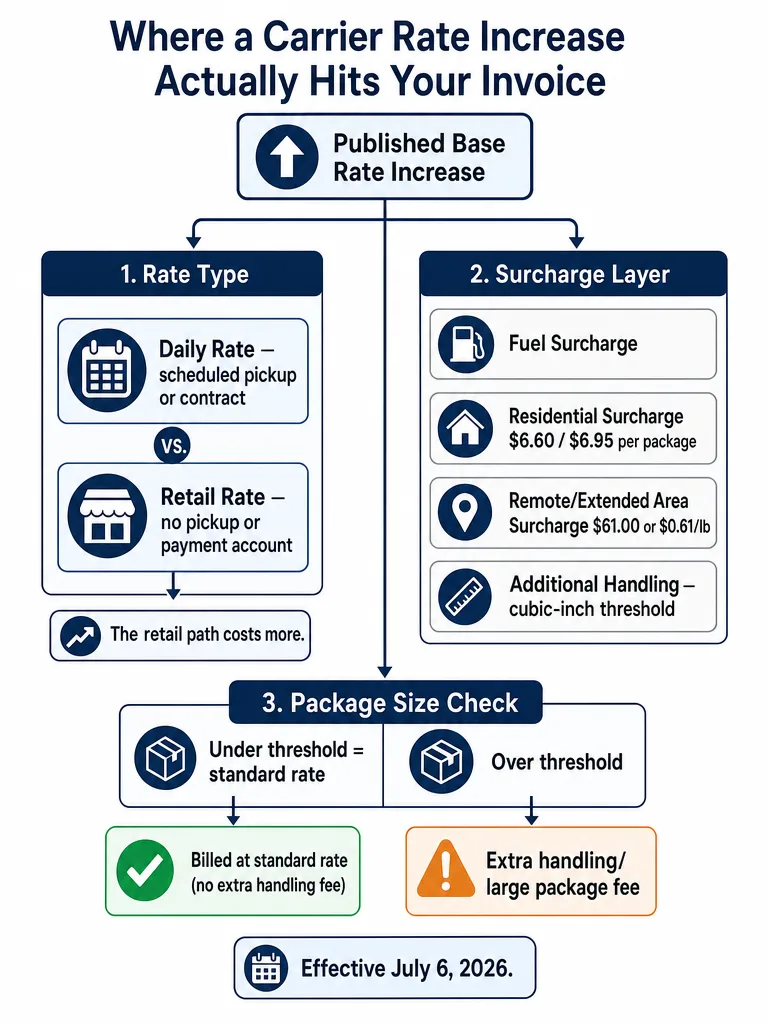
UPS's own shipping costs and rates guidance splits pricing into two tracks: Daily Rates, for shippers with a scheduled pickup or a UPS contract that provides daily rates, and Retail Rates, for shippers who ship from a UPS location, don't have a payment account or scheduled pickup, or ship infrequently using a payment card. UPS says the final cost of any shipment still depends on origin, destination, service level, and package weight.
That distinction matters more than any headline update. Two businesses shipping the identical box can land on two different invoices, not because UPS changed the rate twice, but because they were priced under different rate structures before the July 6, 2026 guide update ever took effect.
Why Does a Modest UPS Rate Increase Turn Into a Bigger Hit on Your Invoice?
A UPS rate increase advertised as a modest average number rarely matches what shows up on an invoice, because most small-shipper contracts price a percentage discount off UPS's published rate, not a flat dollar figure. When the published rate rises, the dollar value of that discount rises with it, even though the discount percentage itself never moved.
Here's the arithmetic. Negotiate a 30% discount off a $10.00 published rate, and you pay $7.00. If UPS raises that published rate 5%, to $10.50, your 30% discount still applies, just against a bigger number: 30% off $10.50 comes to $7.35. Your discount didn't change. The figure it's calculated from did.
The discount percentage on a UPS contract doesn't move when base rates rise. The number it's multiplied against does.
The base rate is often the smaller problem anyway. Surcharges layered on top, for fuel, residential delivery, additional handling, and oversized packaging, move on their own schedule throughout the year and can add up faster than any single published percentage suggests. That's where the next real cost increase usually hides.
What UPS Surcharges Are Rising Alongside the Base Rate?
UPS raised several surcharges independently of any base-rate update, and those changes often cost small shippers more than the published rate ever will. Effective July 6, 2026, UPS increased its Extended Area Surcharge, its Pickup Area Surcharge, and its Remote Area Surcharge, alongside higher residential delivery fees, according to UPS's own rate guidance. The available UPS source does not give 2026 dollar amounts for the Domestic Delivery Area Surcharge or the Domestic Additional Handling Charge on standard small-package shipments, so treat those two as open questions until your own invoice or carrier rep confirms a figure.
| Surcharge | Applies To | New Amount | Effective Date |
|---|---|---|---|
| Extended Area Surcharge | Shipments to extended delivery areas | Greater of $61.00 per shipment or $0.61/lb | July 6, 2026 |
| Pickup Area Surcharge | Express Freight or Express Freight Midday shipments only | Greater of $61.00 per shipment or $0.61/lb | July 6, 2026 |
| Remote Area Surcharge | Non-U.S. origins and destinations only | Greater of $61.00 per shipment or $0.61/lb | July 6, 2026 |
| Residential Surcharge, UPS Standard Services | Standard domestic residential deliveries | $6.60 per package | July 6, 2026 |
| Residential Surcharge, International Air & UPS 3 Day Select | International Air Services and 3 Day Select residential deliveries | $6.95 per package | July 6, 2026 |
| Domestic fuel surcharge calculation, UPS Ground / Ground Saver | Domestic Ground and Ground Saver shipments | 18.75% fee instead of 17.75% at a $3.20/gal diesel index | May 26, 2025 |
| International Collect on Delivery Fee | International shipments where duties/taxes aren't prepaid | $12 per shipment | June 2, 2025 |
| Non-Compliant Label Fee, UPS Ground Saver | UPS Ground Saver packages with non-compliant labels | $5.00 per package | August 2, 2026 |
UPS also changed how it calculates fuel surcharges. Supply Chain Dive reported that UPS raised its domestic fuel surcharge calculation by 100 basis points on May 26, 2025, on top of a 50-basis-point increase just three months earlier. The same reporting noted that UPS and FedEx have picked up the pace of surcharge changes in recent years, and that discounts offered to contract customers only partly offset the added cost.
A full breakdown of what changed and where to check it against your own invoices sits in the 2026 UPS and FedEx surcharge list.
What Triggers UPS Large Package and Additional Handling Fees in 2026?
UPS no longer relies only on length-plus-girth to decide when a bulky package earns an extra fee. Effective August 17, 2025, UPS shifted its Domestic Large Package Surcharge and Domestic Additional Handling Charge to cubic-inch thresholds, according to Supply Chain Dive's reporting, and that change moves the packaging risk small shippers carry even when nothing about their carrier contract or rate type changes.
Under the new math, a package becomes subject to the Domestic Large Package Surcharge once it exceeds 110 pounds or 17,280 cubic inches. The Domestic Additional Handling Charge kicks in above 8,640 cubic inches. Supply Chain Dive reported that shippers moving bulkier items, such as patio furniture, aftermarket car parts, or recreational equipment, carry the most exposure to these updated calculations.
That threshold math means two boxes with identical length-plus-girth measurements can land in different fee categories depending on how UPS multiplies their actual dimensions. A shipper who redesigns packaging for cost or protection reasons, without recalculating cubic volume, can trip a fee they never had to pay last year.
The mechanics of how UPS and other carriers turn box dimensions into a billable weight are covered in DIM weight vs actual weight, including how to check your own boxes against the thresholds before they show up on an invoice.
UPS Daily Rates vs. Retail Rates: Which One Sets Your Price?
UPS prices shipments under two different rate structures, and which one applies depends on how you ship, not how much you ship. Daily Rates apply if you have a scheduled UPS pickup or a UPS contract that provides daily rates. Retail Rates apply if you ship from a UPS location, don't hold a payment account, or ship occasionally using a card, according to UPS's own guidance.
| Rate Type | Who It Applies To | How It's Triggered |
|---|---|---|
| Daily Rates | Shippers with a scheduled UPS pickup or a UPS contract for daily pricing | Set up through a scheduled pickup arrangement or a specific daily-rate contract |
| Retail Rates | Shippers without a payment account or scheduled pickup, or infrequent card-paying customers | Applied automatically at drop-off, no contract required |
A small shipper without a scheduled pickup and without a UPS payment account fits UPS's own description of a Retail Rate customer: shipping from a UPS location, paying by card, or shipping too infrequently to hold an account. What moves a shipment into the Daily Rate structure, per UPS, is a scheduled pickup or a contract that specifically provides daily rates, not simply having an account on file.
Would UPS Simple Rate Cost Less Than Your Current Boxes?
UPS Simple Rate is a flat-price shipping option, priced by box size rather than by zone and dimensional weight, and it's worth comparing against standard pricing for packages that qualify. Prices run from $12.20 for an extra-small box to $30.95 for an extra-large box, covering anything up to 1,728 cubic inches and 50 pounds, according to UPS's developer documentation.
Standard UPS rates price a package by actual weight, dimensional weight, and the zone between origin and destination, so a light package traveling a long distance can still cost more than its scale weight suggests. Simple Rate sets the price by box size and delivery speed alone instead.
The trade-off is the ceiling. Once a package exceeds 1,728 cubic inches or 50 pounds, it falls back to standard dimensional and zone pricing. For anything smaller, running the comparison before defaulting to a standard label is worth the time it takes.
How Can Small Shippers Cut UPS Costs Without Switching Carriers?
Small shippers can cut UPS costs without renegotiating a contract or switching carriers by fixing what's already inside their own invoices and packaging.
- Audit every invoice line, not just the base rate. Confirm each shipment billed under the correct rate type, Daily versus Retail, and check that residential surcharges match the actual delivery address. UPS's own July 2026 update only confirms increases to residential, extended-area, pickup-area, and remote-area surcharges, so don't assume every line item moved by the same amount.
- Recheck packaging against the current cubic-inch thresholds. Supply Chain Dive reported that a box over 8,640 cubic inches trips the Domestic Additional Handling Charge, and one over 17,280 cubic inches or 110 pounds trips the Domestic Large Package Surcharge, regardless of unchanged length-plus-girth measurements.
- Run your smallest, lightest packages through UPS Simple Rate before defaulting to standard pricing. Anything under 1,728 cubic inches and 50 pounds is worth comparing against the flat-rate table UPS publishes.
- Look into pooled or negotiated pricing instead of shopping a new carrier. The UPS and Supply Chain Dive material used here doesn't quantify the exact volume thresholds UPS sets for its pricing tiers or which negotiated contract terms protect smaller shippers from future surcharge changes, so verify any tier number a rep quotes you against your own shipping history rather than taking it at face value.
None of these four checks require dropping a carrier relationship or renegotiating an entire contract. They start with what's already on the invoice: the rate type charged, the surcharges applied, and the packaging dimensions that trigger extra fees. More on how shippers typically approach volume-based pricing tiers is covered in small parcel shipping rates 2026.
Frequently asked questions
What was UPS's average general rate increase for 2026?
UPS's 2026 general rate increase averaged 5.9% across Ground, Air, and International services, according to carrier-rate tracking reports, taking effect for non-contract shipments around December 22, 2025. UPS's own online rate guidance does not list that single average anywhere; it only confirms specific surcharge updates, like the July 6, 2026 increase to extended-area, pickup-area, and residential fees. Check which rate type and surcharge schedule actually apply to your account before assuming the average number matches your invoice.
Where can you get a free shipping cost audit for UPS invoices?
A free shipping audit reviews your UPS invoices line by line, checking that each shipment billed under the correct rate type and that surcharges match your actual delivery addresses and package dimensions. Kadima Logistics runs this kind of audit against real invoice data and returns a written savings analysis, without requiring you to switch carriers. Any audit worth using should show you the specific lines where your invoice deviates from your negotiated discount or UPS's published surcharge schedule.
Can small shippers negotiate better UPS pricing without high volume?
Yes, through pooled or negotiated pricing arrangements that combine multiple businesses' shipping volume rather than through a single company's shipment count. UPS's own guidance and current surcharge reporting don't publish the exact volume thresholds UPS sets for its pricing tiers, so any tier number a carrier rep or partner quotes should be checked against your own shipping history before you rely on it. Smaller shippers typically gain more from fixing invoice errors and surcharge mismatches than from chasing a volume discount alone.
Did FedEx also raise its rates alongside UPS in 2026?
Yes. FedEx matched UPS's pattern of raising base rates by an average of 5.9% for the third consecutive year, according to shipping industry rate reporting, with its 2026 increase covering U.S. package, export, and import services starting January 6, 2026, about two weeks after UPS's December 22, 2025 effective date. The two carriers' increases don't always line up service by service, so compare your actual invoice lines against each carrier's effective date rather than assuming identical timing.
What is UPS's minimum shipping charge in 2026?
UPS raised its minimum published shipping charge from $11.32 to $11.99 in the same 2026 rate cycle that included its general rate increase, according to shipping industry rate reporting. FedEx made an identical adjustment. That minimum applies to the smallest, lightest packages, which are also the shipments most likely to already sit near a carrier's price floor, so a small percentage move on the minimum charge can be a bigger proportional hit than the same move on a heavier package.
How much did the UPS Large Package Surcharge and SurePost rates increase recently?
UPS's Large Package Surcharge for Commercial Zones 5 and 6 rose 9.2%, from $250 to $273, in a recent rate cycle, and UPS SurePost rates climbed 9.9% in the same year, according to shipping industry rate tracking. These accessorial charges move on their own schedule, separate from the advertised general rate increase, and they tend to hit shippers moving oversized, lightweight, or residential-bound packages harder than the headline percentage suggests.
Sources
- UPS Shipping Costs and Rates Guideswww.ups.com
- UPS Rate Hike Forces DTC Brands Into Multi-Carrier Pivots – Ecommerce Timeswww.supplychaindive.com
Keep reading
One short note, every other Tuesday. Nothing else.
The patterns we're seeing across thousands of carrier invoices, written up tight. Unsubscribe with one click.