What GPO Shipping Rates Are and When They Make Sense
GPO shipping rates are shared carrier pricing tied to membership, not your own shipping volume. This guide shows when they fit parcel and freight spend, when an RFP makes more sense, and how to compare any offer against your invoices.
What are GPO shipping rates?
GPO shipping rates are pre-negotiated carrier or supplier terms you access by joining a group purchasing organization, not a custom carrier contract you negotiate alone. Instead of building leverage from your own volume, you tap a contract that a larger buying group already signed. Amazon Business defines a group purchasing organization as an entity that combines the purchasing power of multiple businesses to secure better pricing and more favorable contract terms than any member could get on its own.
Applied to parcel and freight, that means a shipper joins the GPO, gets access to its negotiated rate structure, and starts shipping under those terms.
The plain-English version:
GPO shipping rates are shared carrier pricing you qualify for by membership, not by your own shipping volume.
That distinction matters for two reasons. First, the terms are standardized. You take the contract mostly as written, rather than shaping every zone, weight break, and surcharge concession around your profile. Second, access is fast, because the negotiation already happened.
One caution on the acronym. Search results for "GPO" mix procurement group purchasing organizations with the U.S. Government Publishing Office, which runs GPOExpress, a federal FedEx Office print-discount program. Those are unrelated. This article is about procurement GPOs and the carrier rates they unlock, not government printing.
How does a GPO work?
A group purchasing organization pools the buying volume of many businesses, then acts as a middleman between those members and vendors to lock in discounts. Amazon Business describes it as an intermediary that gives members access to pre-negotiated contracts with top suppliers, so a single company doesn't have to win those terms alone.
The mechanics are simple. The GPO negotiates once, at scale. Members sign on and inherit the result.
There are two structural flavors. Horizontal GPOs serve many industries and focus on indirect spend, office supplies, IT equipment, fleet, and the like. Vertical GPOs concentrate on one sector, such as healthcare or manufacturing, and negotiate specialized products for that field. Shipping usually falls under the horizontal, indirect-spend bucket.
The model isn't new. Amazon Business traces the first GPO, The Hospital Bureau of New York, to 1910, with just 10 healthcare GPOs still operating by 1962. By 2007, it says, there were hundreds across the United States. Shipping is a much more recent addition to the same playbook.
Are GPOs good for shipping?
Shipping is one of the strongest categories for the GPO model because the specifications are highly standardized. Una, a group purchasing organization, identifies shipping as a prime indirect-spend fit precisely because carrier services behave like commodity purchases, similar boxes, similar zones, similar surcharges across most shippers. That uniformity is what makes a shared contract work.
When a category is standardized, a member doesn't lose much by taking pre-negotiated terms instead of custom ones. The contract already covers what most shippers need.
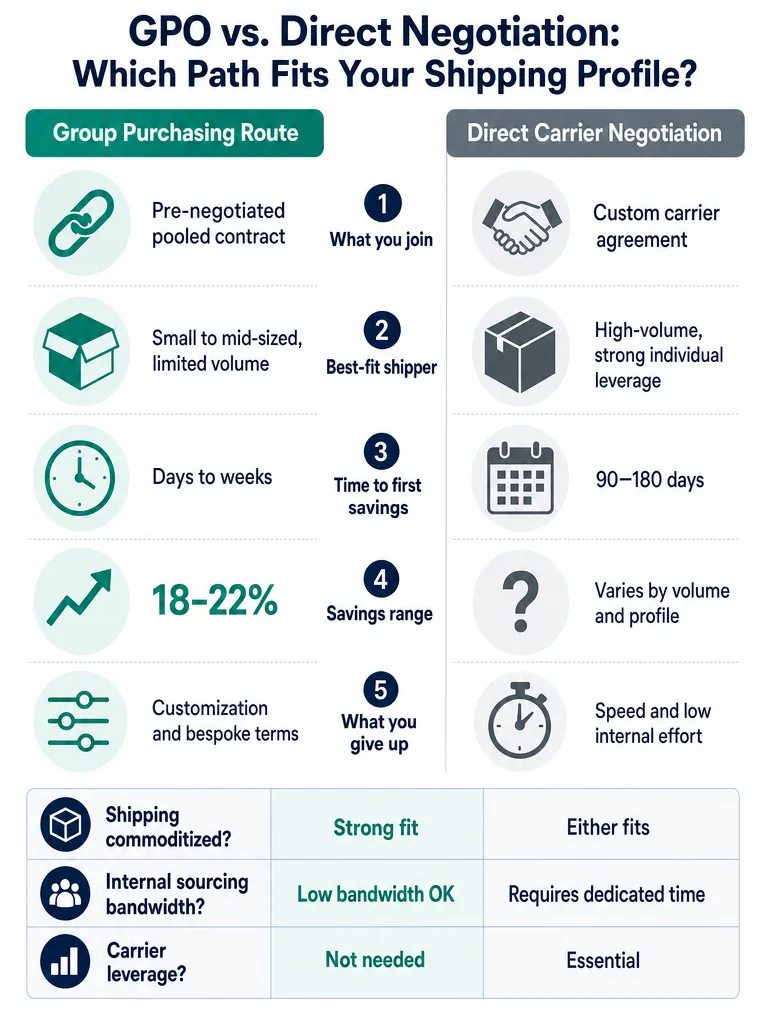
Speed is the other reason shipping fits. Una's decision framework puts the GPO route in the days-to-weeks range for time to value, versus a full sourcing event that runs far longer. For a business watching costs climb, that gap is the whole appeal.
That last point is the real argument for a shipping GPO. If your own volume can't move a carrier, borrowed volume might.
Get your free shipping audit: Get your free shipping audit
When should you use a GPO vs. an RFP?
Use a GPO when shipping is standardized and your team lacks the bandwidth or leverage to run a full sourcing event. Run your own RFP when shipping is core spend, or when your volume is large enough to command better terms than the shared contract. Una frames the split by resource cost and time to value: the GPO route is low-resource and reaches value in days to weeks, while a standalone RFP may take 90–180 days.
The decision comes down to three tests. Is your shipping profile standardized? Do you have internal sourcing bandwidth? Do you have enough carrier leverage to win on your own?
| Factor | Lean GPO | Lean RFP |
|---|---|---|
| Shipping profile | Standardized, commodity-like | Complex, custom service needs |
| Time to value | Days to weeks | 90–180 days |
| Internal resources | Limited sourcing bandwidth | Dedicated procurement team |
| Your volume | Below strong-leverage threshold | High enough to command terms |
| Spend type | Indirect, non-core | Core direct spend |
Neither path is permanent. A smaller shipper can start with GPO rates for fast savings, then graduate to a direct negotiation once volume grows. The mistake is assuming one answer fits every category on the invoice.
What types of businesses benefit most from a GPO?
Small and mid-sized businesses gain the most from a GPO because they usually lack the purchasing volume to win strong supplier terms alone. Amazon Business says the approach tends to be most beneficial for SMBs that don't typically have access to deals tied to purchasing volume, even though organizations of any size can use pre-negotiated contracts.
That's the core problem GPOs solve. A smaller shipper often pays the same rate at higher order quantities because it can't clear a carrier's volume threshold. The GPO clears it for them.
The fit is strongest when three things line up:
- Your shipping is standardized, mostly common parcel or freight lanes.
- Your annual volume falls below the level carriers reward with their best direct pricing.
- Your team doesn't have the time or expertise to run a months-long negotiation.
Larger shippers can still join, but the calculus shifts. Once your volume is big enough to command custom terms, a direct carrier agreement may beat the shared rate. That's a comparison worth running before you commit either way.
How much can a GPO save?
Published GPO savings run 10–25% annually across spending categories, per Amazon Business, while Una cites a tighter 18–22% range for its GPO contracts specifically. Amazon Business attributes the wider figure to tapping collective buying power; Una presents its range as the immediate savings a member captures by joining a pre-negotiated contract instead of running a separate event.
Two cautions before you bank on those numbers.
First, they're cross-category, not shipping-specific. Neither source breaks out parcel or freight savings by carrier, zone, or weight tier, so treat the percentages as a directional expectation, not a quote for your invoices.
Second, the baseline matters. A shipper already on sharp direct rates has less room to gain than one paying off-benchmark pricing. The only honest way to size the number is against real invoice data.
What do you give up with GPO shipping rates?
The main tradeoff is customization: GPO shipping rates give you fast access to standardized terms, but not a contract shaped around your specific service needs, lane mix, or packaging profile. You take the shared contract largely as written. A direct carrier agreement, by contrast, can be negotiated line by line around how you actually ship.
That's the flip side of the speed advantage. The reason a GPO reaches value in days to weeks, per Una's framework, is that the negotiation already happened without you in the room.
For a standardized shipper, that's a fair trade. For a shipper with unusual requirements, custom service commitments, heavy dimensional-weight exposure, specific accessorial patterns, the standardized contract may leave money and flexibility on the table.
Public detail is limited here. The available sources don't break out whether GPO shipping rates include or exclude fuel surcharges, residential fees, or dimensional-weight terms, and they don't publish member fees, lock-in, or termination terms. Those specifics vary by GPO and belong in any offer you evaluate.
The right question isn't "how good are the GPO rates?" but "how do these terms compare to what my own invoices and volume could win?" You can't answer that without seeing both.
What is the difference between a GPO and a buying group?
A GPO provides access to pre-negotiated supplier contracts, while a buying group combines businesses to purchase the same product in bulk. Amazon Business draws the line clearly: a group purchasing organization secures group discounts and favorable contract terms across categories, whereas a buying group forms specifically to buy one product at bulk prices.
The example Amazon gives: multiple schools in a district pooling orders for classroom supplies and equipment. That's group buying, one product, bulk quantity, better unit price.
For shipping, the GPO structure is the relevant one. You're not co-buying a single SKU. You're gaining access to negotiated carrier terms across your shipments. Keep the terms straight when you evaluate an offer, because they solve different problems.
How to check GPO rates against your current carrier invoices
Compare any GPO offer against your own invoices before you sign, because a published rate means nothing until it's measured against what you actually pay. Pull recent statements from every carrier you use, UPS, FedEx, USPS, DHL, or Amazon Shipping, and match the GPO's terms against your real weight tiers, zones, surcharges, and minimum charges.
Work through it in order:
- Gather 30 to 90 days of invoices across all active carriers.
- Map your volume by weight break and zone, then find where the GPO rate applies.
- Layer in surcharges, fuel, residential, and accessorials often decide the winner more than base rates.
- Compare the all-in cost to the GPO rate, not the headline discount.
- Test whether your own volume could beat the shared contract with a direct negotiation.
That last step is where many shippers find a better answer than the GPO offer. If you use multiple carriers, the cheapest option shifts by weight, zone, and service, and surcharge lines are where overcharges hide. A rate card without an invoice audit behind it is a guess.
Working every carrier on your invoice, rather than juggling separate relationships, is exactly the task an invoice audit and rate comparison is built for. Kadima Logistics reviews your real invoice data and returns a written savings analysis, so you can weigh a GPO rate, a direct carrier agreement, and your current spend against actual numbers instead of a percentage. Get your free shipping audit.
Frequently asked questions
What are GPO shipping rates?
GPO shipping rates are pre-negotiated carrier terms you access by joining a group purchasing organization — not a custom contract you win alone. The GPO pools volume from many businesses, negotiates once at scale, and you inherit the result. According to Amazon Business, the model tends to benefit smaller shippers most, since they often pay the same per-unit rate at higher volumes because they can't clear a carrier's threshold on their own.
How much can a GPO save on shipping costs?
Published figures run 10–25% annually across spending categories, per Amazon Business, while Una cites a tighter 18–22% for its own contracts. Neither source breaks those numbers out by carrier, zone, or weight tier. Your actual result depends on your current rates, carrier mix, and surcharge exposure — a shipper already on sharp direct pricing has less room to gain than one paying off-benchmark rates.
When should you use a GPO vs. running your own carrier RFP?
Use a GPO when your shipping is standardized and your team lacks the bandwidth or leverage for a full sourcing event. Run your own RFP when shipping is core spend or your volume is large enough to command custom terms. Una's decision framework puts the GPO route at days to weeks for time to value; a standalone RFP can take 90–180 days. Neither path is permanent — smaller shippers can start with GPO rates and graduate to direct negotiation as volume grows.
What do you give up with GPO shipping rates compared to a direct carrier contract?
You give up customization. GPO terms are standardized — you take the contract largely as written, rather than negotiating every zone, weight break, and surcharge line around your actual shipping profile. Shippers with unusual service needs, heavy dimensional-weight exposure, or specific accessorial patterns may leave money on the table. The available sources don't publish whether GPO shipping contracts include or exclude fuel surcharges, residential fees, or lock-in terms, so those details belong in any offer you evaluate directly.
What types of businesses benefit most from a GPO for shipping?
Small and mid-sized businesses gain the most. Amazon Business states the GPO model is most beneficial for SMBs that don't typically have access to deals tied to purchasing volume. The fit is strongest when three things align: your shipping is mostly standardized parcel or freight lanes, your annual volume falls below the level carriers reward with their best direct pricing, and your team doesn't have the time or expertise to run a months-long negotiation.
Where can I get a free shipping cost audit to compare GPO rates against what I actually pay?
A free invoice audit is the only honest way to size any rate comparison. You need 30–90 days of real carrier invoices across UPS, FedEx, USPS, DHL, or Amazon Shipping, mapped by weight break, zone, and surcharge — because surcharges often decide the winner more than base rates. Kadima Logistics reviews your actual invoice data and returns a written savings analysis so you can weigh a GPO rate, a direct carrier agreement, and your current spend against real numbers.
Sources
- What Does Flat Rate Shipping Mean? Check Our Cheat Sheet - Shippowww.instagram.com
- How do you all deal with General Rate Increase from Carrier? - Redditbusiness.amazon.com
- GPOE Brochure May 1 2026 Online Brochure Final_www.facebook.com
Keep reading


One short note, every other Tuesday. Nothing else.
The patterns we're seeing across thousands of carrier invoices, written up tight. Unsubscribe with one click.