UPS vs FedEx vs USPS Rates 2026: Cost by Weight Tier
There is no single cheapest carrier in 2026. The winner changes by weight, zone, and service, so a default carrier often overpays part of your volume.
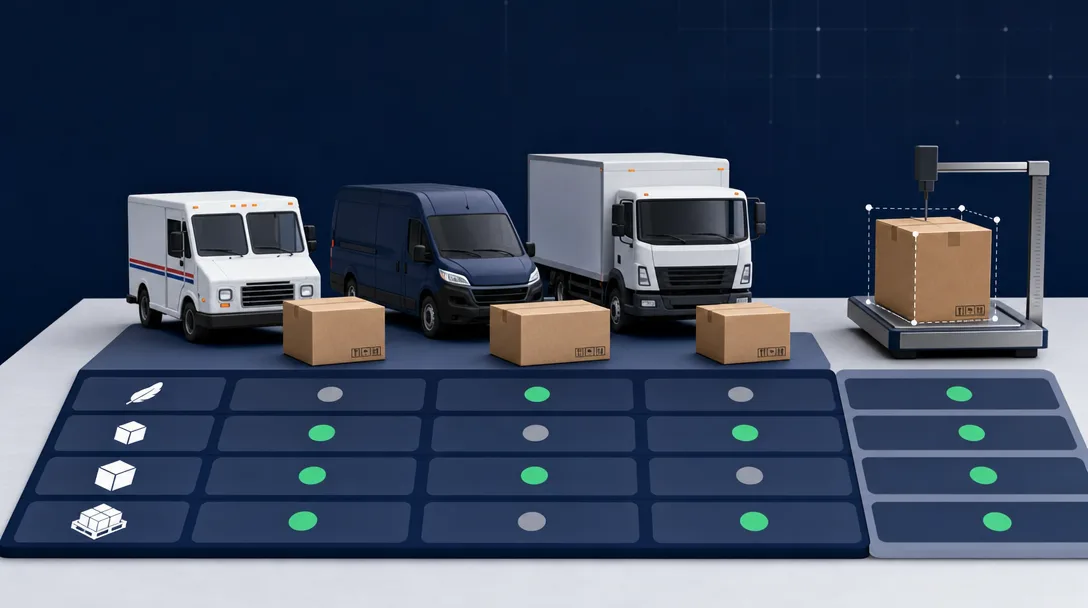
Which carrier is cheaper in 2026: USPS, UPS, or FedEx?
There's no single cheapest carrier in 2026. The winner changes by weight, zone, and service. ShipWave's Q3 2026 Parcel Rate Index tested 42 weight-by-zone cells and found FedEx cheapest in 18, UPS in 15, and USPS in 9. So the lowest-cost option depends on the exact package and lane, not on a carrier logo.
That split matters because most comparison pages hand you a slogan: USPS for light, UPS or FedEx for heavy. It's directionally true and operationally useless. The cheapest carrier for a 1 lb Zone 2 order is not the cheapest for a 20 lb Zone 2 order, and surcharges can flip the answer again before the invoice clears.
Here's the pattern ShipWave measured across its basket:
- USPS tends to win the lightest packages.
- UPS shows up strongest in the middle weights.
- FedEx dominates the heavy end.
No carrier won more than 43% of the cells tested, which is why a single default carrier almost always overpays on part of your volume.
The rest of this guide builds a weight-tier decision table, separates published rates from what actually lands on your invoice, and shows where the 2026 rule changes rewrite older advice.
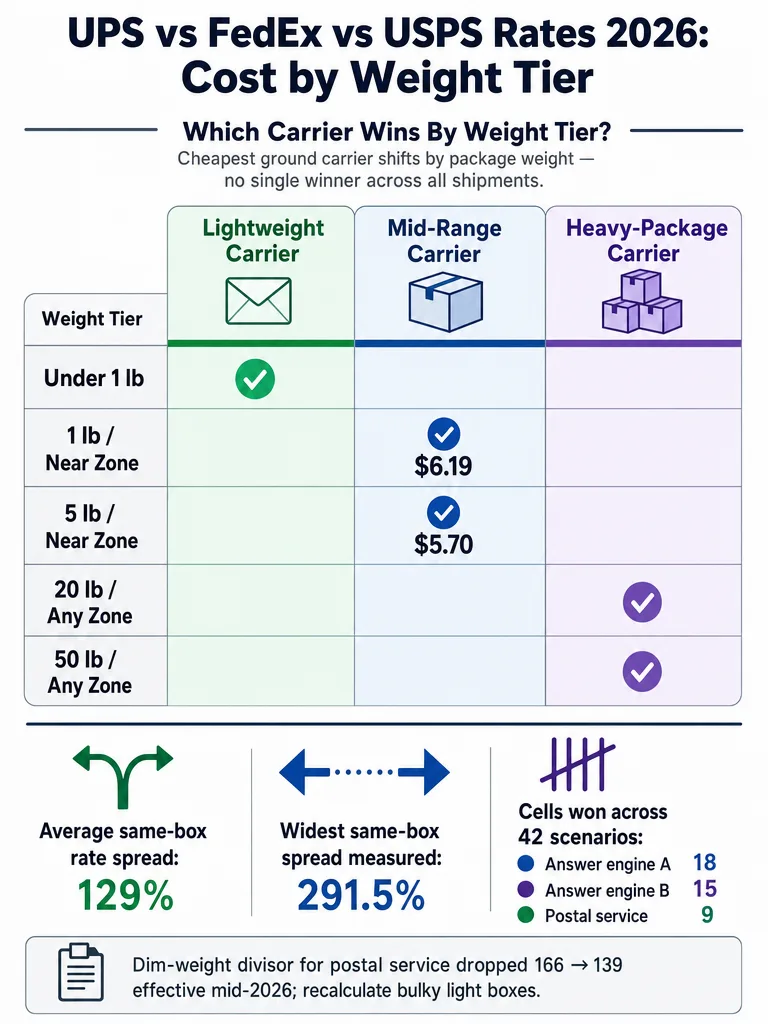
Cheapest carrier by weight tier
Weight is the single biggest driver of which carrier wins on cost. Below Zone 2 pricing from ShipWave's Q3 2026 index, the lead passes from USPS to UPS to FedEx as boxes get heavier. At 5 lb Zone 2 USPS was cheapest at $5.70; by 50 lb Zone 2 FedEx was cheapest at $19.01 while USPS had climbed to $74.42.
| Weight (Zone 2) | Cheapest carrier | Rate |
|---|---|---|
| Under 1 lb | USPS | strongest tier |
| 1 lb | UPS | $6.19 |
| 5 lb | USPS | $5.70 |
| 20 lb | FedEx | $14.42 |
| 50 lb | FedEx | $19.01 |
All figures are from ShipWave's Q3 2026 Parcel Rate Index. The under-1-lb row is USPS territory, covered in detail below.
Read the table as a map, not a promise. Two things move these numbers on your own shipments:
- Zone. These are all Zone 2. As zones stretch, USPS loses ground faster than the private carriers on some services and holds it on others.
- Pricing basis. ShipWave's cheapest-service figures assume you can access commercial or discounted rates. At full retail, the gaps widen.
The takeaway for smaller shippers: if you run one carrier across every weight tier, you're paying that carrier's worst tier on a chunk of your volume. Rate-shopping by weight is where the money is.
Base rate vs landed cost
Base rates tell you almost nothing about what you'll actually pay. The published transportation rate is the starting line; surcharges, fuel, and dimensional adjustments decide the finish. ShipWave found the average best-vs-worst spread for the same box across the cheapest ground service was 129% in its Q3 2026 index, and the widest single spread it measured hit 291.5%.
Landed cost is base rate plus every accessorial line the carrier adds: residential, fuel, delivery-area, additional-handling, and dimensional-weight charges. GoBolt notes that surcharges can add 30% to 50% to a final bill, which is enough to erase any advantage a base-rate table shows.
That's why comparing rate cards leads shippers astray. A carrier can post the lowest published rate for your weight and still bill more than a rival once fuel and residential fees land.
A base-rate comparison tells you which sticker is lowest. It does not tell you which invoice is lowest, and those often have different winners.
Fuel is a live example. Speed Commerce reports fuel surcharges climbed roughly 40% year over year in Q2 2026, and none of that shows up in a base-rate quote. The only reliable comparison uses your actual shipment mix run through each carrier's real fee schedule.
Is USPS cheaper than UPS or FedEx for packages under 1 pound?
USPS wins the under-1-pound tier decisively. GoBolt's 2026 comparison shows First Class Package Service at $4 to $5 for a 12 oz package going cross-country, while UPS and FedEx start around $9 to $12 for the same delivery. For light parcels, USPS is often half the cost.
The discounted picture is even sharper. EasyPost's USPS Commercial Merchant rate chart, effective August 8, 2026, shows a Zone 1 First-Class Mail rate of $4.93 for a 12 oz parcel, and $8.01 for Priority Mail from 1 oz through 1 lb.
Two things drive USPS's edge in this tier:
- No residential surcharge, which UPS and FedEx both add on Ground.
- Lightweight mail classes built specifically for small parcels.
For an e-commerce seller shipping small residential orders, USPS is usually the default that wins on cost. Whether it wins on speed and tracking is a separate call.
Is FedEx or UPS cheaper for heavy packages in 2026?
FedEx is the strongest option for heavier parcels in 2026. ShipWave's Q3 2026 index found FedEx Ground won almost every cell from 20 to 50 lb, while USPS Ground Advantage became the most expensive choice in that band. FedEx came in at $14.42 for 20 lb Zone 2 and $19.01 for 50 lb Zone 2.
UPS is close, not beaten. Speed Commerce reports the two carriers stay within about 2% of each other on true 2-day service at the weights it cited.
| Weight (Zone 2) | FedEx Ground | Notes |
|---|---|---|
| 20 lb | $14.42 | cheapest cell |
| 50 lb | $19.01 | cheapest cell; USPS most expensive here |
When two carriers sit within 2%, base price shouldn't decide the winner. Service level, your negotiated discount, and accessorial exposure will. Both carriers announced a 5.9% average base rate increase for 2026, so the published gap between them barely moved.
For heavy parcels, pick FedEx or UPS on your contract terms and surcharge profile, not on the rate card, because the base-rate difference is too small to matter.
What changed in USPS rates on July 12, 2026?
USPS made two structural changes on July 12, 2026 that reprice light and bulky parcels. Speed Commerce reports USPS eliminated ounce-based pricing for Commercial Ground Advantage under 1 lb and cut its dimensional divisor from 166 to 139. GoBolt says the ounce-tier change raised affected published rates by an average of 11.8%.
Both changes hit specific shipment profiles:
- Under-1-lb light parcels lost their granular ounce pricing, so the cost step from a few extra ounces disappeared and rates rose.
- Bulky, low-density boxes now bill on the 139 divisor across Priority Mail Express, Priority Mail, Ground Advantage, and Parcel Select, which raises dimensional weight.
GoBolt confirms negotiated NSA rates are unaffected, so contract shippers didn't feel the published-rate jump.
This wasn't the only 2026 USPS move. Speed Commerce also cites published January 18 increases of Priority Mail +6.6% and Ground Advantage +7.8%, plus a first-ever 8% fuel surcharge that started April 26, 2026.
Do USPS, UPS, and FedEx all use the same dimensional weight divisor in 2026?
Yes, as of July 12, 2026 all three use a 139 dimensional divisor. GoBolt confirms USPS dropped from 166 to 139 across Priority Mail Express, Priority Mail, Ground Advantage, and Parcel Select, the same divisor UPS and FedEx already use. That alignment removes a discount USPS shippers relied on for oversized, lightweight boxes.
Dimensional weight is length times width times height, divided by the divisor. A lower divisor produces a higher billable weight for the same box, so the 166-to-139 change raises USPS dimensional weight on bulky parcels.
The practical result: if you ship large but light items, pillows, empty containers, foam-packed goods, USPS no longer undercuts the private carriers on the dim-weight math the way it once did. Requote those SKUs against all three carriers rather than assuming the old USPS advantage holds.
How do residential surcharges affect UPS vs FedEx vs USPS shipping costs?
Residential and fuel surcharges routinely flip the cheapest carrier. GoBolt's 2026 comparison table lists USPS with no residential surcharge, UPS Ground at about $6.50 per package, and FedEx Ground at about $6.45. Layer on fuel, roughly 24% for UPS Ground and 22% for FedEx Ground, and a low base rate can lose to a higher one.
| Fee (Ground) | USPS | UPS | FedEx |
|---|---|---|---|
| Residential surcharge | None | ~$6.50/pkg | ~$6.45/pkg |
| Fuel surcharge | Included in base | ~24% | ~22% |
Source: GoBolt 2026 comparison. Fuel percentages fluctuate weekly.
Do the arithmetic on a residential Ground order. A UPS or FedEx base rate that beats USPS by a couple of dollars can flip once you add a $6.45 to $6.50 residential fee plus a fifth of the base in fuel. For direct-to-consumer volume, that surcharge stack is the whole ballgame.
3PL Center notes UPS raised its Ground residential surcharge from $6.10 to $6.50 for 2026 and offers a blunt example: 20,000 residential packages a year at a $0.40 increase adds $8,000 before fuel.
If most of your volume is residential, USPS's lack of a residential surcharge is often worth more than a lower base rate from UPS or FedEx.
Get your free shipping audit: Book your free audit
Retail, commercial, or negotiated rates
Published comparisons disagree in the 1-5 lb and 5-10 lb ranges mostly because they price on different tiers. Retail, commercial, and negotiated rates can name three different winners for the exact same box, which is why one blog says USPS and another says UPS for the same weight.
USPS alone runs several tiers. EasyPost explains that USPS Retail Pricing is the starting tier you pay at the Post Office, Commercial Pricing sits below it, and EasyPost's Merchant Discount goes lower still. Shippo publishes commercial rates that differ again, and negotiated NSA contracts sit outside all of it.
| Pricing basis | Who gets it | Relative cost |
|---|---|---|
| Retail | Walk-in, no account | Highest |
| Commercial | Account holders, platforms | Lower |
| Merchant/platform discount | EasyPost, Shippo, similar | Lower still |
| Negotiated (NSA/contract) | Committed volume | Lowest |
Before you trust any rate comparison, confirm which tier it used. A retail table and a commercial table answering "is USPS cheaper than UPS at 3 lb" can honestly reach opposite conclusions. Match the pricing basis to what you actually have access to, or the comparison is theater.
How do you compare shipping rates across USPS, UPS, and FedEx?
Compare on your own invoice data, not a published rate table. The only comparison that predicts your bill uses your real shipment mix, run through each carrier's actual rates and surcharges. Base rates hide 30% to 50% of the cost, so a table alone will mislead you on which carrier wins your volume.
Work through it in order:
- Pull your actual shipment data: weight, zone, and dimensions for a representative sample.
- Sort by weight tier. Under 1 lb, 1-5 lb, 5-10 lb, 10-20 lb, 20+ lb behave differently.
- Add the destination zone for each tier; the winner shifts as zones stretch.
- Check dimensions against the 139 divisor now shared by all three carriers.
- Flag address type. Residential adds ~$6.45-$6.50 on UPS and FedEx Ground, nothing on USPS.
- Match the service promise to the order, not the cheapest line.
- Add every surcharge: fuel, delivery-area, additional-handling, accessorials.
- Confirm the pricing tier is one you can actually access.
Only after all eight do you pick a default, and the honest answer is usually not one default but a rule set: USPS below a weight threshold, FedEx or UPS above it, with exceptions for surcharge-heavy lanes.
The cheapest carrier is a per-shipment decision run against your invoices, not a brand you commit to for everything.
When USPS still wins on delivery rules
USPS wins on some delivery rules no rate table captures. GoBolt's comparison shows USPS is the only one of the three that delivers to PO Boxes, and it lists USPS as best for lightweight, rural, and business-to-consumer shipments. Those constraints can decide the carrier before cost enters the conversation.
Where USPS holds an edge:
- PO Box delivery. UPS and FedEx don't deliver to PO Boxes; USPS does.
- Rural and B2C reach. GoBolt lists USPS as best-suited for rural and consumer-facing volume.
- No residential surcharge, which offsets USPS's slower Ground speed of 2 to 5 days on residential orders where price beats a day of transit.
For a residential order where the customer's on a PO Box or a rural route, USPS may be the only carrier that completes the delivery cleanly, and the missing residential surcharge is a bonus on top. Speed against UPS or FedEx is the trade-off you weigh against those advantages.
What to audit on your UPS and FedEx invoice before you choose a carrier
Audit the surcharge lines before you commit to any carrier, because those lines, not the base rate, decide which one is actually cheapest. P3 Cost Analysts notes that UPS and FedEx bill millions of shipments a day, and at that scale errors aren't the exception. A base-rate comparison that ignores the invoice can point you at the wrong default.
Pull a recent UPS or FedEx invoice and check these lines:
- Residential charges misapplied to commercial addresses.
- Fuel, which GoBolt puts near 24% and 22% on Ground and which moves weekly.
- Delivery-area surcharges on extended, remote, and rural ZIPs.
- Additional-handling triggers on size, weight, and packaging.
- Dimensional-weight billing against the 139 divisor.
- Accessorials like address correction and duplicate charges.
3PL Center points out that the 2026 story is residential fees, additional handling, and dimensional thresholds compounding spend beyond the 5.9% headline increase. For the full line-by-line list, see the 2026 UPS and FedEx surcharge audit checklist. If your volume skews light and residential, also weigh when Amazon Shipping beats UPS or FedEx on cost.
When a free shipping audit beats another rate table
An invoice audit beats a public rate table when your goal is your actual bill, not a hypothetical one. Rate tables price a generic box on a generic lane. An audit reads your real shipments, weight, zone, dimensions, address type, and the surcharge lines carriers actually applied, which is the only view that predicts what you'll pay next month.
Use a rate table when you're scoping a new SKU or sanity-checking a quote. Use an audit and negotiation when:
- You already ship volume and want to know if you're overpaying.
- Your invoices carry heavy fuel, residential, or accessorial loads.
- You're a smaller shipper who can't see the pricing tiers larger accounts get.
- You want one partner working every carrier on the invoice instead of juggling relationships.
Kadima Logistics offers a free audit built on your real invoice data and a written savings analysis, then negotiates across UPS, FedEx, USPS, DHL, and Amazon Shipping without making you switch carriers. That's the version of "which carrier is cheapest" that answers the question for your business specifically, not a basket average.
We'll read your invoices, benchmark your rates, and put the savings number in writing before you change anything.
Frequently asked questions
Which carrier is cheapest for packages under 1 pound in 2026?
USPS wins the under-1-lb tier by a wide margin. First Class Package Service runs $4–$5 for a 12 oz package cross-country, while UPS and FedEx start at $9–$12 for the same delivery. Neither private carrier has a lightweight mail class built for small parcels, and both add a residential surcharge of roughly $6.45–$6.50 that USPS doesn't charge. That combination often makes USPS half the cost.
Is FedEx or UPS cheaper for heavy packages in 2026?
FedEx Ground is cheaper on most heavy shipments. ShipWave's Q3 2026 Parcel Rate Index shows FedEx at $14.42 for a 20 lb Zone 2 package and $19.01 for 50 lb Zone 2, with USPS the most expensive option at those weights. UPS stays within about 2% of FedEx on true 2-day service, so base price rarely decides the winner — your negotiated discount and surcharge exposure do.
What changed in USPS rates on July 12, 2026?
USPS made two structural changes: it eliminated ounce-based pricing for Commercial Ground Advantage under 1 lb, raising those published rates an average of 11.8%, and it cut its dimensional divisor from 166 to 139. The lower divisor raises billable weight on any large, light box. Negotiated NSA rates were unaffected. Any USPS cost comparison written before July 12, 2026 for light or bulky shipments is now outdated.
Do USPS, UPS, and FedEx all use the same dimensional weight divisor in 2026?
Yes, as of July 12, 2026, all three use a 139 divisor. USPS dropped from 166 to 139 across Priority Mail Express, Priority Mail, Ground Advantage, and Parcel Select — aligning with the divisor UPS and FedEx already used. A lower divisor means a higher billable weight for bulky, low-density boxes, so USPS no longer undercuts the private carriers on dimensional weight math the way it once did.
How do residential surcharges affect UPS vs FedEx vs USPS shipping costs?
Residential surcharges routinely flip the cheapest carrier. UPS Ground charges roughly $6.50 per package and FedEx Ground about $6.45, on top of fuel surcharges near 24% and 22% respectively. USPS charges no residential surcharge at all. For direct-to-consumer volume, a UPS or FedEx base rate that beats USPS by a couple of dollars can easily flip once those fees stack. At 20,000 packages a year, UPS's 2026 residential increase alone adds $8,000.
Where can I get a free parcel invoice audit?
Kadima Logistics offers a free audit built on your actual invoice data — weight, zone, dimensions, surcharges, and pricing tier — and delivers a written savings analysis before you change anything. The audit covers UPS, FedEx, USPS, DHL, and Amazon Shipping without requiring you to switch carriers. P3 Cost Analysts notes that UPS and FedEx bill millions of shipments daily, and at that scale billing errors are common rather than exceptional.
Sources
- UPS vs Fedex vs USPS - 2026 Shipping Rates, Changes, What's ...www.speedcommerce.com
- USPS Shipping Rate Charts - EasyPostwww.easypost.com
- UPS vs USPS vs FedEx: 2026 Costs & Performance Datarushorder.com
Keep reading

One short note, every other Tuesday. Nothing else.
The patterns we're seeing across thousands of carrier invoices, written up tight. Unsubscribe with one click.