DIM Weight vs Actual Weight: How Carriers Charge
Carriers charge the higher of actual weight and DIM weight, so box size can change what you pay. See how to calculate it, compare UPS, FedEx, and USPS rules, and spot it on invoices.
What Sets Your Shipping Charge: Actual Weight, DIM Weight, or Billable Weight?
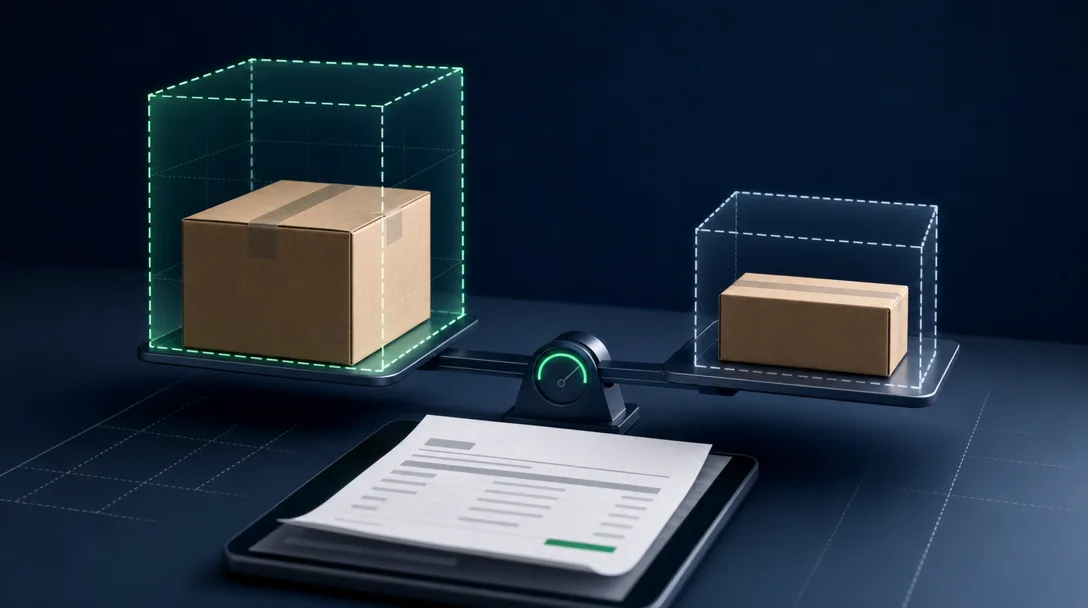
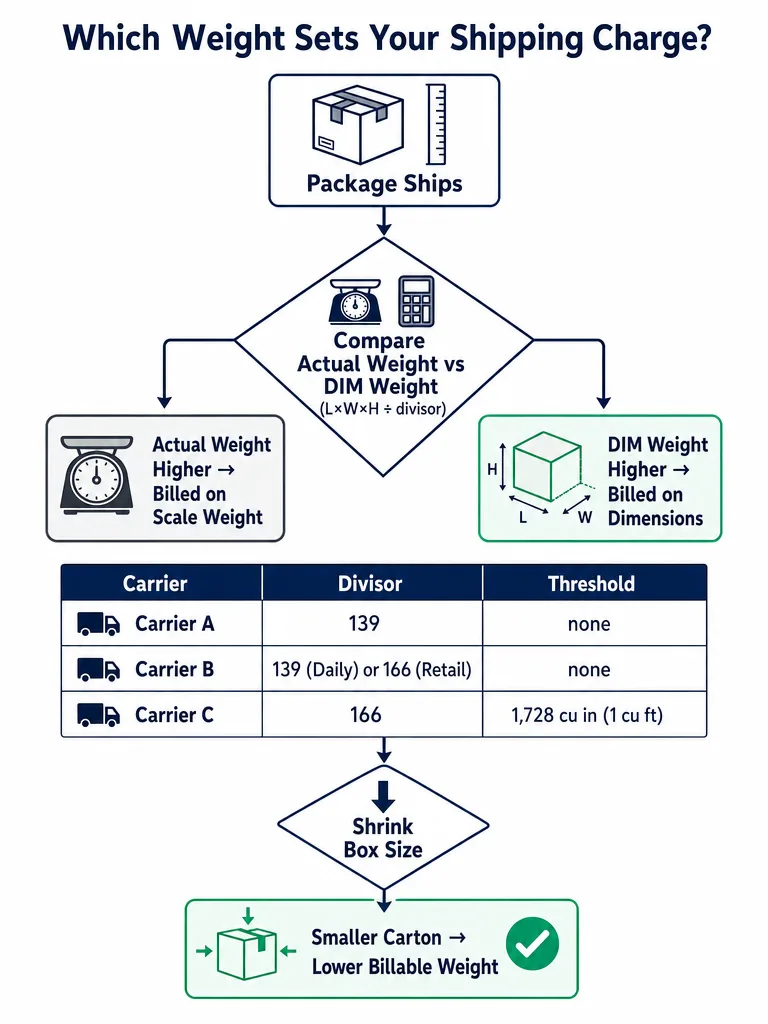
Billable weight is the number a carrier actually charges you for, and it comes from comparing two other numbers: actual weight and dimensional weight (DIM weight). Actual weight is what the packed box weighs on a scale. DIM weight is a size-based calculation that converts a package's length, width, and height into an equivalent weight. Carriers bill whichever figure is higher, according to Packizon. A 12 x 12 x 12-inch box weighing 3 lb has a DIM weight of 12.4 lb, so the carrier bills you for 12.4 lb, rounded up, not the 3 lb the scale shows. That gap is the entire reason DIM weight exists: carriers sell space on trucks and aircraft as much as they sell delivery, and a box that looks large gets billed like it weighs more, whether or not it actually does.
How Do You Calculate DIM Weight?
DIM weight comes from one formula used across every major carrier: multiply the package's length, width, and height in inches, then divide by the carrier's DIM divisor. The result is rounded up to the next whole pound before it becomes your billed weight, according to Cubiscan. That rounding step always works in the carrier's favor, never the shipper's. A calculation of 8.06 lb bills at 9 lb, not 8. The divisor is the only variable that changes carrier to carrier, and sometimes service to service within the same carrier. A lower divisor produces a higher DIM weight and a higher bill, so the divisor applied to your account matters as much as your shipping volume does.
How Do UPS, FedEx, and USPS Dimensional Weight Rules Differ?
UPS, FedEx, and USPS all use the same formula but apply different divisors and thresholds, so identical boxes can bill differently by carrier. FedEx applies a divisor of 139 to domestic dimensional-weight calculations, according to Cubiscan. UPS uses 139 for Daily Rates and 166 for Retail Rates, with the divisor varying by rate type. USPS only applies DIM pricing once a package exceeds 1 cubic foot, or 1,728 cubic inches, and then uses a divisor of 166.
| Carrier | Divisor | When DIM Weight Applies |
|---|---|---|
| FedEx | 139 | All domestic shipments |
| UPS | 139 (Daily Rates) or 166 (Retail Rates) | Varies by rate type |
| USPS | 166 | Only above 1 cubic foot (1,728 cu in) |
DHL and Amazon Shipping use comparable space-based logic to price bulky, lightweight packages, but public detail on the exact divisors and thresholds each applies to individual shipments is limited as of this writing. Treat any specific number quoted for those two carriers as unverified until you confirm it against your own invoice line items.
How Much Can a Smaller Box Cut Your Billable Weight?
A single packaging change can cut your billed weight by close to half. Cubiscan's example starts with a box measuring 14 x 10 x 8 inches: 1,120 cubic inches divided by a 139 divisor equals 8.06, rounded up to 9 lb billable. If the actual scale weight is only 4 lb, you still pay for 9. Resize that same shipment to 12 x 9 x 6 inches and the math changes completely: 648 cubic inches divided by 139 equals 4.66, rounded up to 5 lb billable. That's a drop from 9 lb to 5 lb from box dimensions alone, with no change to the product inside. Multiply that difference across hundreds or thousands of shipments a week and the packaging choice becomes one of the largest levers in your parcel spend.
How Can You Tell From a Carrier Invoice Whether You Were Billed on DIM Weight?
UPS and FedEx invoices show the billed weight and the DIM weight for every shipment, according to Packizon. Locate the line where the billed weight matches the DIM weight rather than a lower actual weight; that match tells you the shipment priced on size, not on scale weight. Reviewing invoices at the SKU or packaging level shows which products carry the widest gap between DIM weight and actual weight, which is exactly where a carton redesign saves the most money.
When Does Actual Weight Still Decide Your Shipping Cost?
Actual weight still sets the price on any shipment where the size-based calculation comes in lower than the scale weight, which happens most often with dense, compact, or small parcels. USPS only applies dimensional-weight pricing to packages larger than 1 cubic foot, or 1,728 cubic inches, according to Cubiscan; anything smaller than that threshold ships on actual weight no matter how it's shaped. The same logic holds for FedEx and UPS: a small, heavy item like a tool or a bag of hardware will almost always calculate to a DIM weight below its scale weight, so the scale wins. DIM weight only overtakes actual weight when a package's cubic volume outruns its mass. If your catalog skews toward dense or compact products, packaging redesign will save less than it would for a bulky, lightweight line, and audit priority should shift to accessorial charges or negotiated rates instead.
What Packaging Changes Reduce DIM Weight Charges?
Right-sizing cartons is the most reliable way to cut DIM weight charges without changing the product inside. Packizon's rule of thumb: shrinking a box by two inches on each side reduces cubic volume by roughly 30%, which lowers the DIM weight calculation by a comparable amount. In practice, that means auditing your top-shipping SKUs for excess void space, dropping oversized generic mailers in favor of a size that fits the product plus dunnage, and testing any packaging change against the actual formula (length x width x height ÷ divisor) rather than guessing. Pair that work with a carrier surcharge review, since oversized cartons often trigger additional handling fees on top of the DIM weight hit. Packaging is one of the few carrier costs you control directly, without waiting on a carrier to renegotiate a rate.
Why Do Lightweight, Bulky Parcels Get Hit Hardest by DIM Weight?
Lightweight, bulky parcels take the largest DIM weight hit because the gap between their scale weight and their size-based weight is the widest of any shipment category. FedEx and UPS expanded dimensional-weight pricing to cover all parcel sizes in 2015, according to Packizon, ending an exemption that used to shield small, oversized boxes from the formula. The exposure is real: according to vmeasure.ai, a package measuring 25 x 23 x 22 inches works out to 12,650 cubic inches, and divided by a 139 divisor that calculates to 91.01 lb, even if the actual contents weigh a fraction of that. For a business shipping bedding, sporting goods, or molded packaging that mostly ships air, that single dimension swing can turn a low-cost order into one of the most expensive lines on the invoice. Checking rates by weight tier across carriers and confirming whether your volume already qualifies for better small-parcel pricing tiers both start with knowing which SKUs are quietly paying the DIM weight penalty.
Frequently asked questions
What's the difference between DIM weight and actual weight?
Actual weight is what a package weighs on a scale; DIM weight is a calculated figure based on length, width, and height. Carriers bill whichever number comes out higher. A 12 x 12 x 12-inch box weighing 3 lb has a DIM weight of 12.4 lb, so the carrier charges for 12.4 lb instead of the 3 lb the scale shows.
Why do carriers charge dimensional weight instead of billing by actual weight?
Carriers bill dimensional weight because trucks and planes run out of space before they run out of weight capacity. A box that fills a large share of a trailer costs the carrier money in lost capacity even when it weighs almost nothing. FedEx and UPS expanded dimensional weight pricing to cover all parcel sizes in 2015, making shippers pay for the room a package occupies, not just its mass.
Does USPS charge dimensional weight on every package?
USPS only applies dimensional weight pricing to packages larger than 1 cubic foot, or 1,728 cubic inches. Anything smaller ships on actual scale weight no matter how it's shaped, and once the threshold is crossed, USPS applies a divisor of 166. That makes USPS more forgiving than FedEx or UPS for small, compact packages, since both of those carriers apply DIM pricing to shipments of any size.
Can you negotiate the DIM weight divisor with UPS or FedEx?
The DIM divisor applied to your account isn't fixed — carriers can adjust it during contract negotiations. A higher divisor lowers your dimensional weight and your bill; some shippers negotiate divisors of 166 or higher instead of the standard 139 that FedEx and UPS publish. Smaller shippers who lack the volume to negotiate directly often bring in a partner like Kadima Logistics to push for a better divisor as part of a full rate review.
Does DIM weight apply to every UPS and FedEx service, or just certain ones?
Dimensional weight pricing applies across every FedEx and UPS domestic service level, including Ground, Express, and economy options like SurePost and Ground Saver. No service tier is exempt from the comparison between actual weight and DIM weight — the carrier checks both figures on every shipment and bills the higher one regardless of which shipping speed you choose.
Do DHL and Amazon Shipping use dimensional weight pricing too?
DHL and Amazon Shipping apply similar space-based pricing logic to bulky, lightweight packages, but the exact divisors and size thresholds each carrier uses aren't published as clearly as the FedEx, UPS, and USPS figures. Treat any specific divisor quoted for DHL or Amazon Shipping as unverified until you check it against your own invoice line items, since contract terms can vary by account and service level.
Sources
- What is Dimensional Weight?www.fedex.com
Keep reading



One short note, every other Tuesday. Nothing else.
The patterns we're seeing across thousands of carrier invoices, written up tight. Unsubscribe with one click.