Free Shipping Cost Audit: What You Get Back
A useful free shipping cost audit gives you a line-by-line findings report, a savings estimate, and specific fixes tied to your invoices. It should show where the money is leaking, not just whether a late-delivery refund exists.
What Do You Actually Get Back From a Free Shipping Cost Audit?
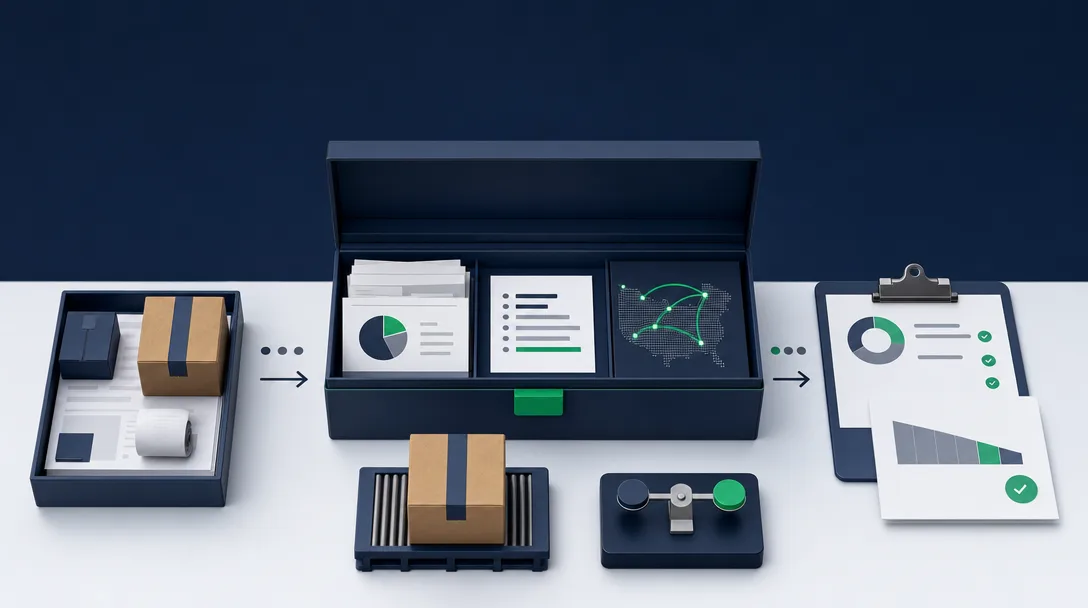
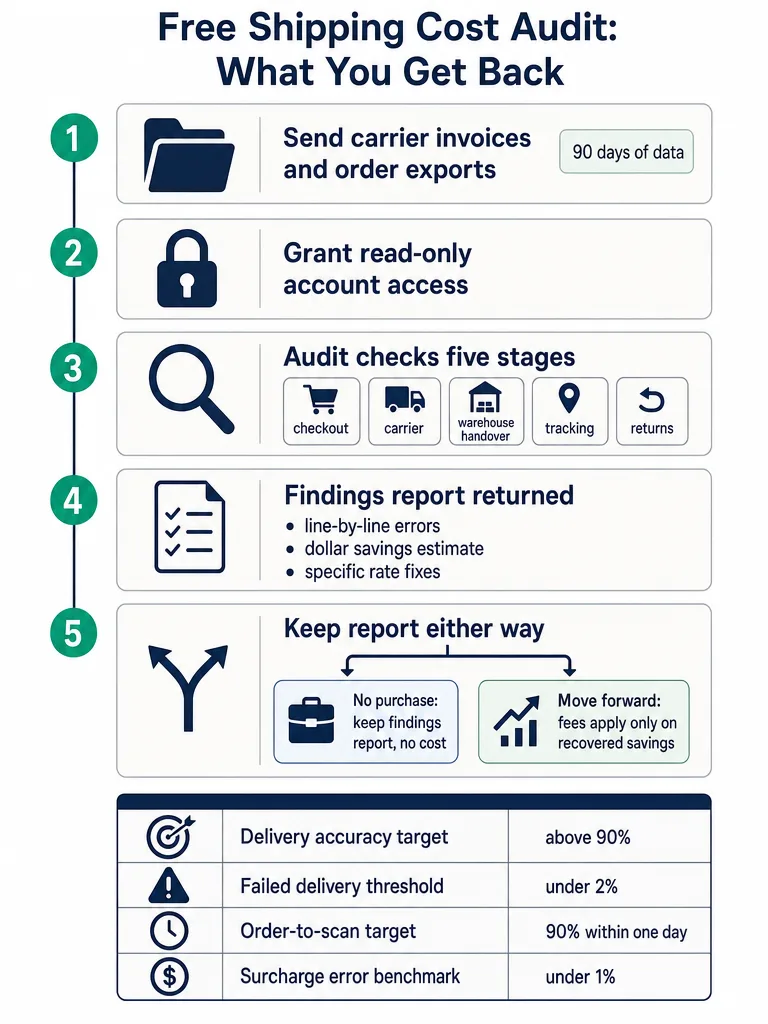
A free shipping cost audit should return three things: a line-by-line findings report, a dollar savings estimate, and specific fixes for the overcharges or off-benchmark rates found on your invoices. It should go well past a late-delivery refund check, covering billing errors and surcharge mistakes across every carrier on your account.
The report is the part that matters most. A good one names the invoice lines, not just a total number at the bottom. That means flagging the specific duplicate charges, DIM-weight mismatches, address-correction fees, and service failures it found, with the dollar amount tied to each one. If a savings estimate has no line items behind it, you can't verify where the number came from, and neither can anyone reviewing it after you.
What you shouldn't accept is a report that only chases late-delivery refunds. A findings report that stops there leaves rate mismatches, surcharge errors, and missed discount tiers completely unexamined, even though they're typically where the bigger dollar amounts sit on a full invoice review.
The better free audits also point toward what could happen next, whether that's a direct carrier credit, a conversation about your current rates, or a pricing tier you might qualify for. Not every free audit includes rate negotiation or tier-matching as part of what you get back, so it's worth asking upfront what's actually included before you send your invoices.
What Data Do You Need to Send Before the Audit Can Start?
A useful audit starts with your actual invoices, not a sales call. Hand over recent carrier invoices and a shipment or order export, and an auditor can find real overcharges instead of estimating from industry averages.
The specific inputs:
- Recent carrier invoices. PDFs or data exports from whichever carriers you use, UPS, FedEx, USPS, DHL, or Amazon Shipping. More billing cycles means more patterns an auditor can confirm, not just a one-off error.
- A shipment or order export. This matches each invoice line back to an actual package: ship date, weight, dimensions, and destination. Without it, an auditor can't tell a legitimate surcharge from a wrong one.
- Read-only account access, where it's offered. Some providers offer this option so nothing changes in how you ship and your team doesn't have to rebuild a workflow just to get the audit started. Not every provider requires it.
- Any current rate agreement, if you have one. It tells the auditor what you're supposed to be paying before they check what you actually paid.
Turnaround time depends heavily on the provider and how much invoice history you hand over, so it's worth asking directly how long results will take before you send anything.
Is the Audit Free If You Never Buy Anything?
Yes, with many offers. The better free shipping cost audits let you keep the findings report whether or not you ever move forward with a paid service. The free part is the invoice review and the written estimate; any fee, where one applies, is tied to money actually recovered or rates actually improved, not to the audit itself.
That pay-only-if-it-works structure shows up across several free audit offers, though exact terms vary by provider, so it's worth confirming before you hand over invoices. "Free" can mean different things depending on how a provider structures its fee, and some charge a percentage of whatever gets recovered rather than a flat rate.
Kadima Logistics offers a free audit and a written savings analysis built from your own invoice data. If you're already deciding whether to audit your invoices or negotiate directly with a carrier yourself, that's the specific task a free audit is built to answer.
Will It Catch More Than Late-Delivery Refunds?
A real audit catches more than late deliveries. It checks the invoice line against the shipment record for duplicate charges, DIM-weight errors, and surcharges, address corrections and residential fees among them, that get applied even when the original shipment was correct.
Each error type carries a different claim window, and missing it means the money is gone for good. FedEx limits refund claims to 15 calendar days from the invoice date, while UPS allows up to 180 days to file a claim. That gap matters: an audit cadence built around UPS's longer window will miss FedEx claims entirely if it isn't checking invoices more often.
| Error Category | Example | Typical Carrier Claim Window |
|---|---|---|
| Service failure (late delivery) | Package delivered after the carrier's guaranteed date on an eligible service | FedEx: 15 calendar days; UPS: up to 180 days |
| Duplicate charge | Same package billed twice, often after a label void or reprint | Varies by carrier; check your account's billing terms |
| DIM-weight error | Billed weight based on box dimensions instead of actual weight | Varies by carrier; check your account's billing terms |
| Address correction / residential surcharge | Fee applied despite a correct commercial address on the label | Varies by carrier; check your account's billing terms |
For a closer look at one of the more commonly misapplied fees, see what to audit on FedEx's address correction charge.
Does the Audit Cover Your Whole Shipping Program or Just One Carrier?
Scope varies a lot between offers, and it changes what the results actually tell you. A full audit reviews invoice history across every carrier you use, UPS, FedEx, USPS, DHL, Amazon Shipping, over a meaningful stretch of time. A narrow audit might only look at one carrier, one SKU, or a small batch of recent shipments.
Both can be legitimate. A full-program audit tells you where your overall shipping spend leaks and which carrier runs off-benchmark on which lane or service. A narrow sample tells you something real, but only about that slice: one product's shipping cost, or one carrier's billing accuracy, not your whole operation.
The practical difference shows up when you act on the findings. A full-program audit gives you a basis to raise rate or carrier-mix questions with evidence behind you. A single-SKU sample can confirm there's a problem worth investigating, but it can't tell you whether the same error is costing you money on every other product line too.
At What Shipping Volume Do You Need Continuous Auditing Instead of a One-Time Check?
A one-time manual audit works fine for low, predictable volume. Once your shipment count climbs and carrier claim windows run just days or weeks, manual review starts missing claims before anyone on your team even notices they existed.
Manual auditing can work for businesses shipping fewer than 500 parcels a month, but it becomes harder to scale beyond that, according to the shipping-audit guide published by LateShipment. The volume question matters less than the clock: checking invoices by hand once a quarter is manageable at low, steady volume, but it stops working the moment claim deadlines are shorter than your review cycle.
- Estimate your current review cadence. If invoices sit unreviewed for more than a few weeks, you're already past some carriers' claim windows.
- Check your volume trend, not just today's number. Growing shipment counts mean growing invoice line counts, and more lines mean more errors slipping past a quarterly glance.
- Decide based on the gap between your review speed and the carrier's clock, not on a hard volume cutoff. A shipper reviewing invoices weekly can stay ahead manually; one reviewing quarterly often can't.
For more on when a standing audit relationship makes more sense than a periodic internal check, see when a third-party audit beats switching carriers.
How Do the Savings Actually Come Back: Refunds, Rates, or Pricing Tiers?
Savings from a shipping audit come back through up to three distinct paths, and they don't all pay out the same way or on the same timeline. Direct refund credits post to your carrier account after a claim is filed and approved. Renegotiated rates change what you're billed going forward. GPO-tier pricing changes which rate table you're billed from in the first place.
| Savings Path | How It Pays Out | When It Applies |
|---|---|---|
| Direct carrier refund | Credit posted to your carrier account after a claim is filed and approved | Billing errors and service failures found on past invoices |
| Renegotiated carrier rate | Lower per-shipment cost on future invoices after contract terms change | When your current rates sit off-benchmark for your volume and service mix |
| GPO-tier pricing | Access to a better rate table through shared group volume | When your own shipment volume alone wouldn't qualify for that tier |
A free audit's findings report is typically the input for the first path, the refund claim. Getting to a renegotiated rate or a different pricing tier usually means a separate step after the audit, not something baked into the free report itself. If a provider promises all three as part of one free deliverable, it's worth asking exactly what gets handed over and what requires a follow-on service.
Frequently asked questions
Where can I get a free shipping cost audit?
Kadima Logistics runs a free shipping cost audit built from your own UPS, FedEx, USPS, DHL, or Amazon Shipping invoices, returning a written savings analysis you keep regardless of what you decide next. The audit itself costs nothing; any fee applies only after money is recovered or rates improve. Send recent invoices and a shipment export to start, since the review is based on actual billing data, not industry averages.
Do you have to switch carriers to lower your shipping costs?
No. Most savings come from auditing invoices for billing errors, renegotiating rates with your current carriers, or qualifying for group-volume pricing tiers, none of which require moving your shipping to a different carrier. Renegotiated rates change what you're billed going forward under your existing carrier relationships, and refund claims recover money already owed on past invoices without touching your shipping setup at all.
Can a smaller business access the same shipping rates as a large shipper?
Yes, through group-volume pricing tiers that pool smaller shippers' volume to unlock rate tables normally reserved for high-volume accounts. This matters specifically when a business's own shipment count alone wouldn't qualify it for a better rate from UPS, FedEx, USPS, or DHL. It's a separate lever from refund recovery or rate renegotiation, and not every audit offer includes access to it.
How long do you have to file a refund claim with UPS or FedEx?
FedEx limits refund claims to 15 calendar days from the invoice date, while UPS allows up to 180 days to file. That gap matters for how often invoices need review: a claim cadence built around UPS's longer window will miss FedEx claims entirely if invoices aren't checked more frequently. Once a claim window closes, the right to recover that specific charge is gone for good.
Does a shipping audit require handing over control of your carrier accounts?
Not with most providers. Read-only account access is offered by some auditors so nothing changes in how you ship and your team doesn't rebuild a workflow to get started, but it isn't required by every provider. Many audits run on invoices and a shipment export you send directly, with no account connection at all. Ask a provider upfront which access level their process actually needs.
Do carrier refunds post automatically once an audit finds an error?
No. A direct carrier refund only posts to your account after a claim is filed and approved by the carrier; finding the error is a separate step from collecting the money. A free audit's findings report is typically the input used to file that claim, not the payout itself. Getting to a renegotiated rate or a new pricing tier usually requires a further step after the refund claim.
Keep reading


One short note, every other Tuesday. Nothing else.
The patterns we're seeing across thousands of carrier invoices, written up tight. Unsubscribe with one click.