When a Third-Party Audit Beats Switching Carriers
A shipping invoice audit can recover missed discounts, duplicate charges, and bad surcharges before you change carriers. If the issue is structural, then switching may make sense.

When does an invoice audit beat switching carriers?
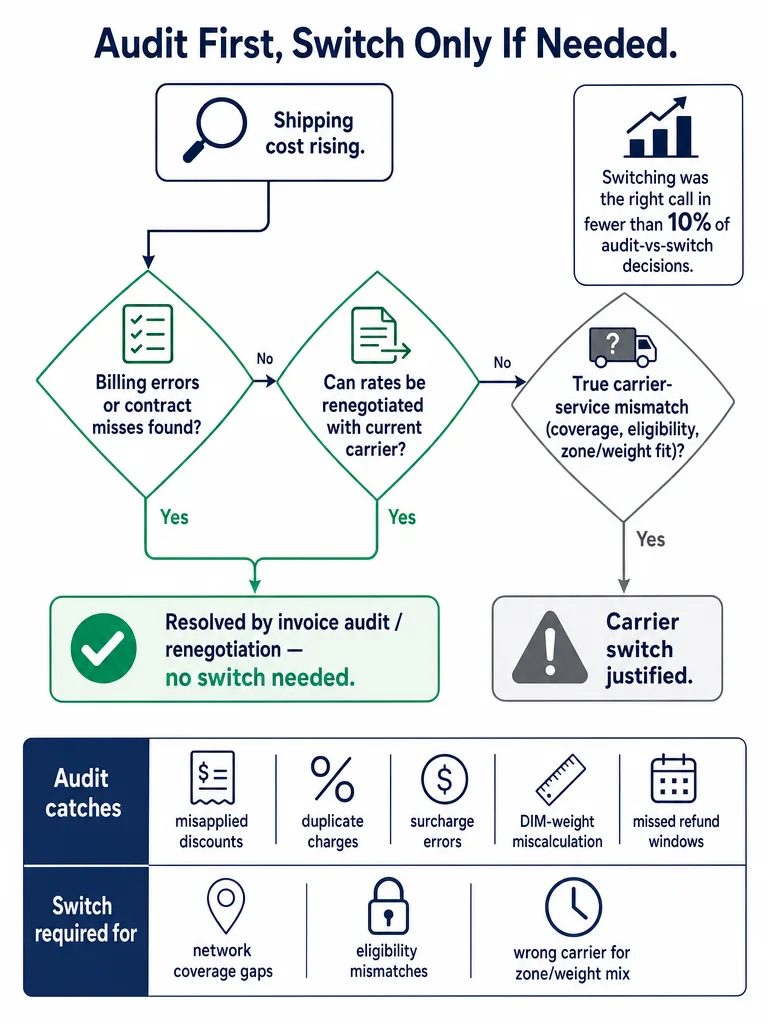
A shipping invoice audit beats switching carriers when the losses trace back to billing errors or contract noncompliance, not a true carrier mismatch. Merchant Monitors reviewed audit-versus-switch decisions across industries in 2026 and found that switching was the right call in fewer than 10% of cases.
That figure comes from payment-processor relationships, not parcel carriers, but the logic transfers: most recurring-vendor cost problems are billing problems in disguise, and a full switch is the expensive way to find that out. A third-party audit is an independent evaluation, run by an outside party, that checks a vendor relationship's accuracy and performance rather than assuming a renewed contract or a switch is the only option, according to Smithers' overview of audit types.
Carrier bill auditing applies that same discipline to UPS and FedEx invoices: checking every rate, discount, and surcharge against your shipping order and your carrier agreement, line by line. Most shipping cost creep isn't a carrier problem at all. It's a billing problem: a negotiated discount that stopped applying, a surcharge that shouldn't have posted, a rate that quietly reverted to list price after a system update.
Switching carriers solves a different problem entirely, one where your current carrier genuinely can't serve your shipment profile at a competitive cost for your weight range, zone mix, or delivery speed. Conflating the two leads shippers to make an operational move, a carrier switch, to fix a billing issue an audit would have caught for a fraction of the disruption.
The practical test: run the audit first. If it surfaces recoverable errors and a path to better contract terms with your existing carrier, you've likely solved the problem. If it comes back clean and the gap is still there, a switch decision has an actual case behind it.
What can a shipping invoice audit actually catch on your bill?
A shipping invoice audit catches four recurring overcharge patterns on UPS and FedEx bills: misapplied negotiated discounts, duplicate billing, invalid or misclassified surcharges, and DIM-weight miscalculation. Each one shows up as a normal-looking line item unless someone checks it against your contract and the shipment that actually moved.
- Misapplied negotiated discounts. Contracts specify a discount off a published rate base. When a system update or account change resets that discount, you're billed closer to list price without any notice.
- Duplicate billing. The same shipment appears twice on an invoice, usually after a voided label or a reprint that the carrier's system didn't fully cancel.
- Invalid or misclassified surcharges. A commercial address billed as residential, a surcharge applied to a shipment that never met the trigger, or a delivery-area surcharge charged on a zone that shouldn't carry one. The 2026 UPS and FedEx surcharge list covers the specific rounding, cubic, and fuel triggers worth checking line by line.
- DIM-weight miscalculation. Carriers bill the higher of actual weight and dimensional weight. A measurement error or a wrong divisor on either side inflates the charge; the mechanics are laid out in how DIM weight compares to actual weight.
None of these require a new carrier relationship. They require someone checking the invoice against the contract and the shipment record, charge by charge. Public detail on how carriers handle refund claims for late guaranteed deliveries is limited as of this writing, so treat that category as a separate check against your own carrier agreement rather than a general rule.
Parcel audit vs rate audit: what's the difference?
A parcel audit and a rate audit check different things on the same invoice. A parcel audit examines individual shipments for service-level failures. A rate audit verifies that every charge aligns with the negotiated carrier contract.
| Parcel audit | Rate audit | |
|---|---|---|
| What it checks | Individual shipment outcomes | Contract compliance across all billed charges |
| Typical catch | Late guaranteed delivery, incorrect address-correction fee | Discount not applied, rate reverted to list price |
| Data needed | Tracking history, delivery timestamps | Full carrier contract and rate schedule |
| Best for | Spotting service failures carrier by carrier | Confirming you're paying the rate you negotiated |
| Runs how often | Per shipment, ongoing | Per invoice cycle, against the current contract |
Most businesses need both. A parcel audit without a rate audit catches late deliveries but misses a discount that silently expired. A rate audit without a parcel audit confirms your contract terms are honored but won't flag a specific shipment that missed its guarantee. Run them together and you get a full picture of where the invoice diverges from what you agreed to pay and what you actually received.
Which shipping cost problems actually require switching carriers?
Switching carriers makes sense when the problem is structural, not a billing error: the wrong carrier for your weight and zone mix, missing coverage in the markets you ship to, or an eligibility gap that no audit can close. An invoice audit recovers money already owed to you; it can't redesign a shipping profile that doesn't fit the carrier you're using.
| Cost problem | Audit can fix it? | Why |
|---|---|---|
| Misapplied discount or duplicate charge | Yes | Verifiable against the contract and shipment record |
| Invalid or misclassified surcharge | Yes | Checked line by line against carrier rules |
| Wrong carrier for weight/zone/service mix | No | Requires a different service or carrier, not a billing fix |
| Missing network coverage in a shipping lane | No | Carrier doesn't serve the lane competitively at any rate |
| Seller Fulfilled Prime eligibility gap | No | Depends on meeting Amazon's program requirements, not invoice accuracy |
A weight-and-zone mismatch is one example of a structural problem an audit can't touch. It tends to surface with lightweight, metro-heavy parcel volume, though independent research comparing audit-versus-switch outcomes specifically for parcel shippers is limited as of this writing. When Amazon Shipping beats UPS or FedEx on cost walks through one shipment profile where that gap shows up. Seller Fulfilled Prime eligibility runs on a separate track from cost entirely: Amazon Shipping eligibility compared with UPS for small parcels covers how that program's requirements differ from standard UPS service for small-parcel sellers. An audit tells you whether you're being billed fairly. It doesn't tell you whether you're shipping with the right carrier for the job.
What does switching carriers actually cost you operationally?
Switching carriers carries real operational cost that rarely shows up in the rate comparison: new account setup, label and systems integration, warehouse retraining, pickup schedule changes, and customer-facing tracking disruption. Merchant Monitors' review of provider-switching decisions found the risk clusters around hardware, integrations, billing systems, and staff retraining; independent research on the operational cost of switching parcel carriers specifically is limited as of this writing, but the same categories of disruption apply once you swap carriers.
For a shipper, that translates into concrete line items. Shipping labels and account numbers change across every system that generates them: your order management platform, your warehouse management system, any scan-based software on the floor. Pickup schedules reset with the new carrier's routes. Staff who've run the same pack-and-ship workflow for years need retraining on a different label format and different pickup cutoffs. Customers who track orders by a familiar tracking number format see a different one mid-relationship, which can generate support tickets even when nothing went wrong.
None of this means switching is never worth it. It means the savings math has to include the transition cost, not just the quoted rate difference. A switch that clears a real cost gap after accounting for disruption is a sound decision. A switch chasing a gap that an audit would have closed anyway is cost added for no reason.
Can you lower rates with your current carrier without switching?
Yes. Packaging and service selection inside your current carrier relationship can cut costs without touching your carrier mix at all. UPS Simple Rate, a flat-pricing option described on UPS's flat rate shipping page, runs from $12.20 for an extra-small package to $30.95 for an extra-large one, for any package up to 1,728 cubic inches.
The trade-off: Simple Rate applies only within the 50 states, not internationally, and packages over 1,728 cubic inches or 50 pounds have to move on standard UPS rates based on dimensional weight and zone instead. For shippers whose packages run small and whose volume doesn't justify a full renegotiation, that flat structure removes DIM-weight guesswork entirely. You know the price before you print the label.
The other lever inside your current carrier relationship is shared-volume pricing. GPO shipping rates pool shipping volume across many businesses so smaller shippers can access pricing tiers normally reserved for high-volume accounts, without changing which carrier moves the package. That's the same mechanism larger shippers use on their own: volume earns better pricing, and pooling volume with other shippers is a way to borrow that leverage without hitting enterprise scale yourself.
Between flat-rate packaging options and pooled-volume pricing, a meaningful share of what looks like a "we need a new carrier" problem is actually a "we haven't used the options already available" problem.
How to decide: audit now, renegotiate, or switch carriers
The decision sequence is audit first, renegotiate second, and only evaluate a switch once both have run their course. Running this in the wrong order is the most common reason shippers end up switching carriers to fix a problem an audit would have caught.
- Check your invoice volume and annual spend. Parcel-specific thresholds for when a formal audit pays off aren't well documented, but the general pattern holds across industries: ITG Group found that a typical mid-market audit uncovers 15% to 30% in recoverable savings, and businesses that haven't been audited in five years or more can see savings as high as 40%. The higher your shipping volume, the more a systematic review is worth running before anything else.
- Identify error patterns, not one-off mistakes. A single wrong surcharge is a correction. A pattern of the same discount failing to apply, or the same surcharge misclassified across months, points to a contract-compliance problem that's been quietly compounding.
- Test renegotiation with your current carrier. Armed with documented error patterns and your actual shipment data, request a rate review. Carriers that know you're tracking compliance tend to hold to negotiated terms more closely going forward.
- Only then evaluate a switch. If the audit comes back clean, the renegotiation stalls, and the gap is structural (wrong service for your weight and zone mix, no coverage where you ship, an eligibility requirement you can't meet), a carrier switch has a documented case behind it instead of a guess.
A free invoice audit is the fastest way to find out which step you're actually on. Kadima Logistics offers this kind of audit against real invoice data for shippers who want that first step done for them.
Frequently asked questions
Where can I get a free shipping invoice audit?
Kadima Logistics offers a free shipping invoice audit built on your real invoice data, delivering a written savings analysis without requiring you to switch carriers. The audit checks every rate, discount, and surcharge against your carrier contract to find errors before recommending any renegotiation or carrier change. It's the fastest way to find out whether your cost problem is a billing error or something that actually requires a different carrier.
What is a shipping invoice audit, exactly?
A shipping invoice audit is an independent review of carrier billing data that checks every rate, discount, and surcharge against your contract and your actual shipment records. It applies the same logic used in third-party carrier audits across industries: verify accuracy before assuming a contract renewal or a carrier switch is the only option. The goal is finding billing errors, not evaluating whether you're on the right carrier.
What's the best way to reduce UPS shipping costs without switching carriers?
UPS Simple Rate, a flat-pricing option, can cut costs without touching your carrier mix at all. It runs from $12.20 for an extra-small package to $30.95 for an extra-large one, for any domestic package up to 1,728 cubic inches, and removes dimensional-weight guesswork since you know the price before you print the label. It only applies within the 50 states; packages over 1,728 cubic inches or 50 pounds still price on standard dimensional-weight and zone-based rates.
How much money can a shipping invoice audit typically recover?
A typical mid-market invoice audit uncovers 15% to 30% in recoverable savings, according to ITG Group, and businesses that haven't been audited in five years or more can see savings as high as 40%. Parcel-specific thresholds for when an audit pays off aren't well documented, but the general pattern holds: the higher your shipping volume, the more a systematic review is worth running before negotiating or switching carriers.
Can smaller shippers get the same pricing tiers as large shippers without switching carriers?
Yes, through pooled-volume pricing. GPO shipping rates combine shipping volume across many businesses so smaller shippers can access pricing tiers normally reserved for high-volume accounts, without changing which carrier moves the package. It's the same mechanism larger shippers use on their own, just borrowed through pooled volume instead of built from a single company's shipment count.
What happens if your carrier audit comes back clean but costs are still high?
A clean audit with persistent costs points to a structural problem, not a billing error, and that's when a carrier switch has an actual case behind it. Structural problems include the wrong carrier for your weight and zone mix, missing network coverage in a shipping lane, or an eligibility gap like Seller Fulfilled Prime requirements that invoice accuracy can't fix. Renegotiation should still happen first; a switch decision follows only after both the audit and renegotiation fail to close the gap.
Keep reading


One short note, every other Tuesday. Nothing else.
The patterns we're seeing across thousands of carrier invoices, written up tight. Unsubscribe with one click.