Free Parcel Audit: What Shippers Should Check First
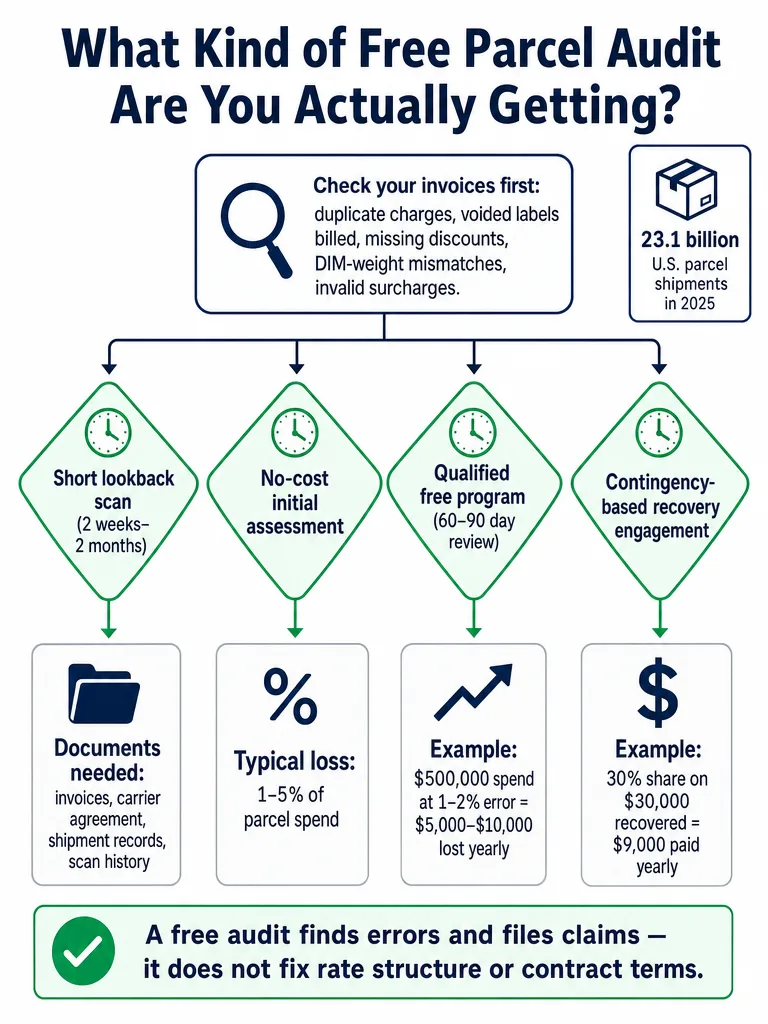
Start with the invoice lines that most often hide overcharges: duplicate charges, voided labels, missing discounts, DIM mismatches, and bad surcharges. A free review can show what’s recoverable before claim windows close.
What Does a Free Parcel Invoice Audit Actually Include?
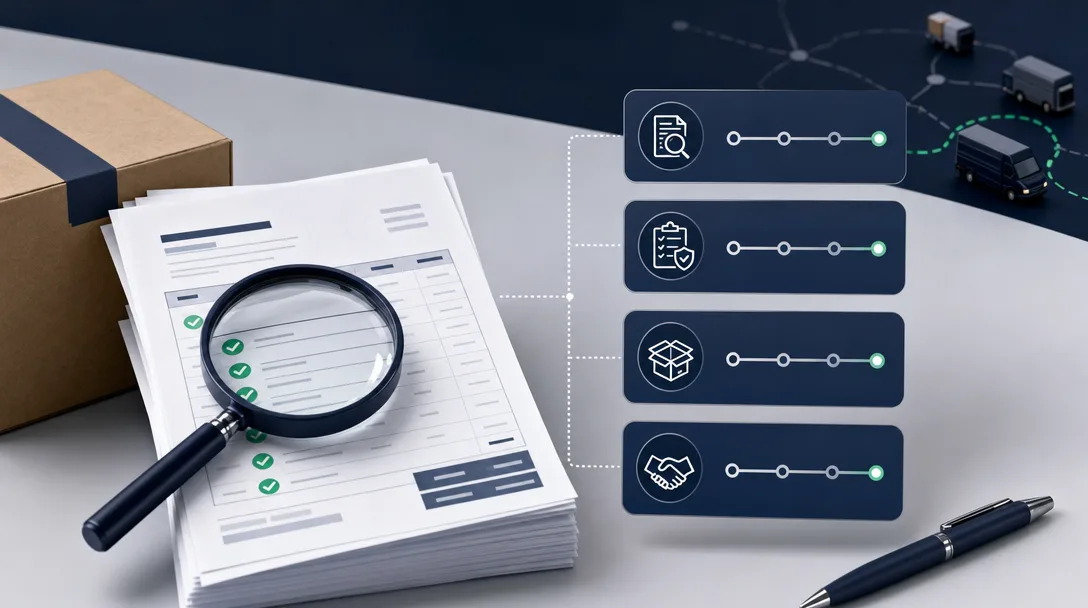
A free parcel invoice audit service usually starts with a short scan of your most recent carrier invoices, not a full dig through your shipping history. The first things worth checking are duplicate charges, voided labels that still billed, missing negotiated discounts, DIM-weight mismatches, and invalid residential or address-correction surcharges across your UPS, FedEx, USPS, or DHL bills.
The word "free" in that phrase usually covers only the initial review, not the full recovery engagement. Checking a recent batch of invoices for errors is one service. Filing the claims and collecting refunds once credits are confirmed is often a separate step, sometimes included at no cost and sometimes billed as a share of what gets recovered.
A parcel invoice audit, in plain terms, is a line-by-line comparison of what a carrier billed against what your contract, published rates, and shipment records say you should have paid.
One 2026 buyer's guide comparing parcel audit software pricing puts typical losses at 1% to 5% of parcel spend lost to billing errors and unclaimed late-delivery refunds each year, money that sits on invoices most shippers never reopen.
That gap persists because of scale. The Pitney Bowes Parcel Shipping Index counts more than 23 billion U.S. parcel shipments in 2025, and each one carries its own surcharge codes, weight tiers, and delivery commitments. At that volume, a handful of errors per thousand packages adds up fast, and almost none of it gets caught without a structured review.
What Should You Check on Your Own Invoices First?
These five checks are a practical first pass before you hand invoices to an outside reviewer. Pull your last two or three months of UPS, FedEx, USPS, or DHL bills and work through them in this order, starting with what's easiest to spot and ending with what requires matching against your own shipment records.
- Duplicate charges. Search for the same tracking number billed twice, or the same shipment split across two line items for one service.
- Voided labels that still billed. A label created and canceled before pickup should never carry a charge. Cross-check every voided label against what actually shows up on the invoice.
- Missing negotiated discounts. Confirm the discount percentage on each line matches your signed rate agreement. A single mismatched tier can erase thousands of dollars over a year without anyone noticing.
- DIM-weight mismatches. Compare the billed dimensional weight against the actual box dimensions and weight recorded at the time of shipment.
- Invalid residential or address-correction surcharges. Check that the billed address type matches the real delivery address, and verify any address-correction fee against the original shipment record rather than accepting it at face value.
Residential, DIM, and surcharge errors tend to cluster in the same invoice sections. Once you've worked through accessorial fees that quietly inflate parcel bills, the next useful step is learning how to read a FedEx invoice line by line so you know exactly where each of these charges sits before you send anything to an outside reviewer.
What Documents Does an Auditor Need to Start?
A credible parcel audit needs four things before it can produce a real finding: your carrier invoices, your signed carrier agreement or rate card, your shipment records, and scan history showing when and where each package actually moved. Without the contract and the shipment data, a reviewer can only guess at what you were supposed to be charged in the first place.
Many free audit offers ask for less than your full shipping history. Instead of requiring complete records up front, free reviews commonly request a short invoice window, anywhere from two weeks to two months of recent bills, so they can show real findings fast without a full onboarding process. That's enough invoice volume to surface recurring patterns, like a DIM error that keeps repeating or a surcharge applied to the wrong address type, even though it won't catch everything a full-history review would.
The address-correction fee is a good example of why the contract and the shipment record matter as much as the invoice itself. Before accepting one at face value, check it against what the FedEx address correction fee actually requires to be valid.
Free Initial Review vs Contingency-Based Recovery: What's the Difference?
A free initial review and a contingency-based recovery engagement wear the same "free audit" label but aren't the same service. The initial review costs nothing and hands you a findings report. The recovery engagement also starts at no upfront cost, but once a provider files claims and collects refunds, it keeps a share of the money found, commonly 25% to 35%, according to a 2026 buyer's guide comparing parcel audit software pricing models.
| Factor | Free Initial Review | Contingency-Based Recovery |
|---|---|---|
| Upfront cost | $0 | $0 |
| What you get | A findings report flagging likely errors | Claims filed and refunds collected on your behalf |
| Invoice window covered | Short lookback, often two weeks to two months | Can extend across your full open claim window |
| Who files the claim | Usually you, after reading the report | The provider, on an ongoing basis |
| How the provider gets paid | Not paid for this step | A share of every dollar recovered, commonly 25-35% |
| Example from one buyer's guide | No cost either way | 30% share on $30,000 of annual recovery = $9,000 a year, every year |
That worked example comes from the same 2026 buyer's guide, not a market-wide average, so treat it as an illustration rather than a benchmark for your own invoices. A 30% contingency share on $30,000 of annual recovery costs $9,000 a year, and that fee repeats for as long as the engagement runs. A free initial review with no ongoing share can be the better deal when your error rate is modest. A contingency engagement makes more sense when the volume of recoverable errors is large enough that a share of the money still beats leaving it unclaimed. Run the comparison against your own invoices before you sign anything.
DIY, Software, or Managed Audit: How Should You Decide?
Shipment volume, not a feature list, should decide this. A shipper moving a small, steady volume each month can often catch the big errors with a periodic manual check. Once volume climbs and multiple carrier accounts are in play, credits on any single invoice start looking too small to chase on their own, and that's exactly when manual review stops getting done.
- Count your monthly package volume across UPS, FedEx, USPS, and DHL. Lower, steady volume is the one case where a manual quarterly check of invoice line items can still catch the big-ticket errors.
- Add up the hours it takes someone on your team to open a dispute, track the claim number, and confirm a credit actually posted. If that process keeps losing out to order fulfillment or customer service, it won't get finished consistently.
- Check how fast your claim windows move. Carriers cap how long a billing dispute or late-delivery refund stays eligible, so a review that happens too late misses the window no matter how clear the error was.
- Match the tool to the volume. If volume is high and the team is thin, a software-based or managed review that files disputes on an ongoing basis is often the most practical model for keeping pace with constant invoice flow.
- Separate a billing problem from a contract problem. If what you keep finding isn't bad invoices but a bad rate agreement, no amount of auditing fixes that by itself. That's when a third-party audit can beat switching carriers as the next move, or it's time to renegotiate instead.
How Long Do You Have Before Refund Windows Close?
Carriers accept disputes and refund claims only inside set windows, not whenever a shipper gets around to checking, according to SmallParcel.com's guide to parcel auditing. That clock runs whether or not anyone on your team is watching the invoice, and once a window closes, the money tied to that shipment is gone no matter how clear the error was.
Exact windows vary by carrier and by claim type, and the research behind this article doesn't cover a current carrier-by-carrier breakdown of UPS, FedEx, USPS, or DHL rules. What's consistent is the practical effect: a credit that looks valid on paper still expires if nobody files before the deadline.
That's why a free audit's lookback window matters as much as its findings. A review that only looks at the last two weeks of invoices will miss errors sitting in older bills that may already be approaching their claim deadline. A review covering two months of invoices has more runway to catch refunds before they expire, but even that can miss anything older than the window itself.
Treat invoice review as a recurring schedule, not a one-time event. A single free review only catches what's inside its lookback window on the day you run it, so anything sitting outside that window needs a separate pass before its own deadline arrives.
What Won't a Free Parcel Audit Fix?
A free parcel audit can flag likely refund claims, but finding an error and collecting the money are two different steps, and the free part often covers only the first one. Filing disputes and tracking credits through to payment can be a separate service, sometimes included at no cost and sometimes handled on a contingency basis once claims are confirmed.
Either way, a parcel audit doesn't rewrite a bad contract or renegotiate a rate that was never competitive in the first place. Those are two different problems: one is billing accuracy, catching errors on invoices already received, and the other is structural, the base rates, discount tiers, and surcharge terms agreed to up front, which no amount of claim-filing changes going forward.
If the audit turns up repeat DIM errors, a surcharge pattern that keeps triggering, or a discount tier that doesn't match your actual volume, that's evidence for the next contract conversation, not just a refund. Kadima Logistics uses that kind of invoice-level finding as a starting point for carrier rate negotiation rather than treating it as a one-time refund check.
A free review that stops at refunds answers one question. Fixing the rate behind those errors is the one that keeps costs down year over year.
Frequently asked questions
Where can I get a free parcel invoice audit?
Kadima Logistics offers a free parcel invoice audit that reviews a recent batch of UPS, FedEx, USPS, or DHL invoices for errors like duplicate charges, DIM-weight mismatches, and missing negotiated discounts, then delivers a written findings report. Many providers that offer this service only cover the initial review for free; filing claims and collecting refunds is often a separate step, sometimes billed as a share of what gets recovered.
What's the best way to lower UPS or FedEx shipping costs without switching carriers?
The fastest path is auditing existing invoices for billing errors and then using those findings to renegotiate rates with your current carrier, not switching providers. A parcel audit catches duplicate charges, invalid surcharges, and DIM-weight mismatches on invoices you already have, and Kadima Logistics uses that invoice-level evidence as the starting point for carrier rate negotiation rather than treating recovered refunds as the end goal.
How much money can a parcel invoice audit typically recover?
Most shippers lose 1% to 5% of total parcel spend each year to billing errors and unclaimed late-delivery refunds, according to a 2026 buyer's guide comparing parcel audit software pricing. That gap persists partly because of scale: the Pitney Bowes Parcel Shipping Index counted more than 23 billion U.S. parcel shipments in 2025, and even a small error rate across that volume adds up to real money sitting unclaimed on invoices.
What's a typical contingency fee for a parcel audit recovery service?
Contingency-based parcel audit recovery services commonly keep 25% to 35% of every dollar they recover, according to a 2026 buyer's guide comparing parcel audit software pricing models. On $30,000 of annual recovery, a 30% share works out to $9,000 a year, every year the engagement runs. A flat-fee or free initial review with no ongoing share can cost less overall when your error rate is modest.
What's the difference between a parcel audit and a freight audit?
A parcel audit reviews small-package invoices from carriers like UPS, FedEx, USPS, and DHL for errors such as duplicate charges, DIM-weight mismatches, and missed late-delivery refunds. A freight audit covers larger shipments, like LTL, truckload, or ocean freight, where billing problems include misclassified freight codes and incorrect rate applications. Parcel shipments involve higher volume and lower cost per package, so parcel audits tend to rely on automated, line-by-line review rather than manual case-by-case checks.
How often should you run a parcel invoice audit?
A parcel invoice audit works best as a recurring process, not a one-time check, because carriers cap how long a billing dispute or refund claim stays eligible. A review that only looks at the last two weeks of invoices misses older errors that may already be close to their claim deadline, so a monthly or quarterly audit schedule catches more refunds before the window closes than a single annual pass.
Keep reading

One short note, every other Tuesday. Nothing else.
The patterns we're seeing across thousands of carrier invoices, written up tight. Unsubscribe with one click.