UPS Daily vs Retail Rates: What Changed in Fall 2026
UPS Daily and Retail rates split on eligibility, not shipping volume. Fall 2026 also brings new fees, updated guides, and a year-end zone change to check on your invoice.
What's the Difference Between UPS Daily Rates and Retail Rates?
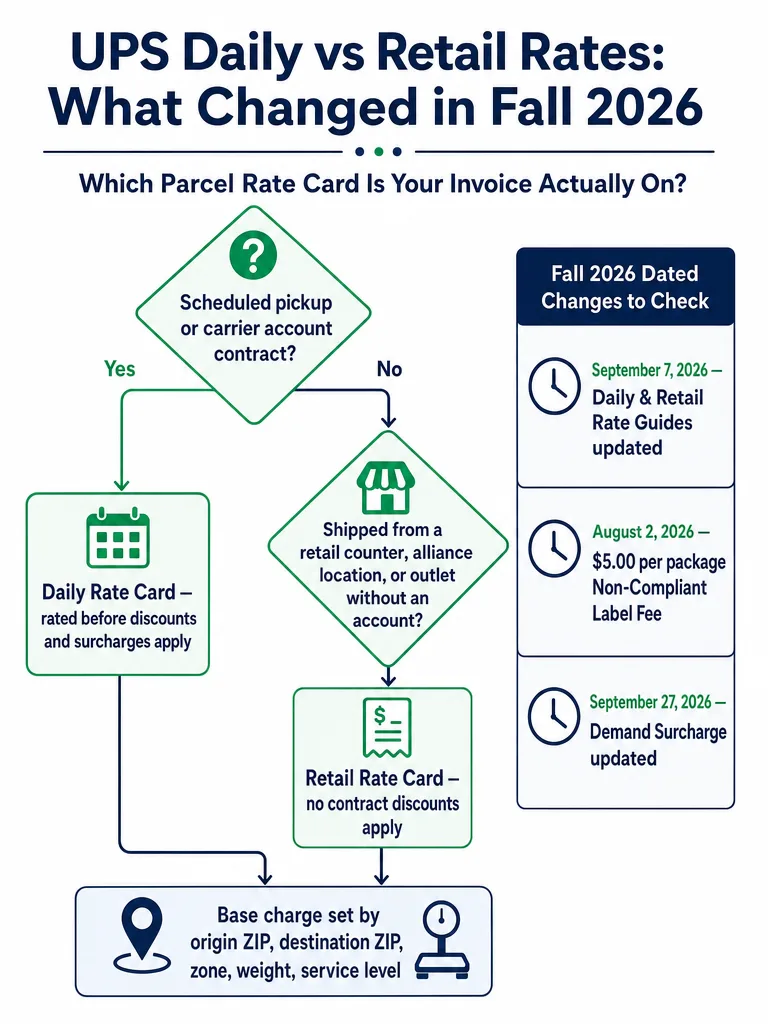
UPS daily rates vs retail rates split on how a shipment is tendered: Daily Rates need a scheduled pickup or a daily-pricing contract, while Retail Rates apply at a UPS Store, Alliance Location, or Authorized Shipping Outlet without an account, per UPS. UPS updated both guides September 7, 2026, then added dated fee changes through December.
A UPS shipping zone is a destination-based geographic region that UPS uses to help price a shipment, and it applies to both rate cards equally. The split that actually determines your card is eligibility. UPS's Daily Rate and Service Guide says Daily Rates apply to accounts that already held daily pricing before July 11, 2016, to any six-digit UPS account established on or after that date, or to any shipper UPS otherwise agrees to in writing. Retail Rates cover walk-in and occasional shippers using a payment card at a UPS location, and UPS notes that a third-party retailer can add its own charges for value-added services on top of the published price.
The practical rule, per UPS's Retail Rate and Service Guide: shippers who don't qualify for Daily Rates get billed at Retail Rates by default. A business can hold a UPS account and still get rated at Retail if the pickup method or the agreement terms don't meet the Daily criteria, which is a detail worth confirming before assuming your invoice reflects the card you expect.
Which UPS Rate Card Is Your Invoice Actually Billed On?
Your invoice is billed on whichever card matches your account type, pickup arrangement, and payment method, not on how much you ship each month. Start by confirming three things: do you have a six-digit UPS account, do you have scheduled pickup service, and does your agreement meet the terms UPS uses to assign Daily pricing. Miss any one of those, and UPS defaults you to Retail Rates, even if you ship every day.
This is also where negotiated discounts enter the picture. Discounts are typically applied as a percentage off the published Daily Rate card, not off Retail Rates, so a shipper paying Retail is usually closer to full published price with less room for a negotiated break. That gap compounds every time UPS raises rates, which is why reviewing how a UPS general rate increase hits small shippers matters more than reading the GRI headline alone.
Once you know your card, check whether the zone, weight, and service combination on each shipment line matches what the guide for that card specifies, before assuming the amount billed is correct.
How Do UPS Zones, Weight, and Service Set Your Base Rate?
A UPS shipping zone is a destination-based geographic region, and UPS combines it with origin, package weight, and service level to produce the starting charge on either rate card. UPS says cost depends on "origin, destination, service, package weight and other considerations," which means the same box can price differently depending on which UPS facility it ships from and which zone chart applies to the destination ZIP code.
Service level does the heaviest lifting after zone and weight. UPS Ground prices by zone and weight with no speed-guarantee premium, while UPS Air services price substantially higher for the same package because they add expedited handling and tighter delivery windows. A shipper comparing two invoices for identical weight and distance but different services isn't comparing like for like unless the service column matches too.
Zone charts themselves aren't static. UPS says the list of ZIP codes aligned to certain zones will change effective December 21, 2026, alongside a separate update to which ZIP codes carry Area Surcharges. A shipment that priced into one zone this fall could land in a different zone by year-end, changing the base rate even if nothing about the shipment itself changes. That's worth flagging now, before the December update takes effect, rather than discovering it on a January invoice.
Are UPS Daily Rates Always Cheaper Than Retail Rates?
No published UPS source states that Daily Rates are always cheaper than Retail Rates on every line item, and treating that as a universal rule is a mistake. What UPS does confirm is eligibility: Daily Rates require an account or a scheduled pickup arrangement, and negotiated discounts apply against the Daily card, which structurally gives account holders more room to lower a bill than someone paying published Retail Rates with no discount applied.
| Factor | UPS Daily Rates | UPS Retail Rates |
|---|---|---|
| Who qualifies | Scheduled pickup or a UPS contract with daily pricing | Shipping from a UPS location, no account, or infrequent card payment |
| Guide updated | September 7, 2026 | September 7, 2026 |
| Negotiated discounts | Typically applied off this card | Rarely available |
| Surcharges (fuel, demand, residential) | Stack on top of base rate | Stack on top of base rate |
| Where you transact | Scheduled pickup, drop box, or account shipping | The UPS Store, Alliance Location, or Authorized Shipping Outlet |
| Third-party added charges | Not applicable | Possible at some retail locations for value-added services |
The honest takeaway: Daily Rates give you access to a negotiated discount that Retail Rates generally don't, per UPS. Whether that discount actually makes Daily cheaper than Retail on a given shipment depends on the size of the discount and the surcharge exposure sitting on top of the base rate, neither of which UPS publishes as a universal comparison. The rate card determines eligibility for savings, not the final number on its own.
What Changed in UPS Rates for Fall 2026?
UPS made six dated changes to its published pricing structure between August and December 2026, each one listed on UPS's own shipping rates page and each separate from the headline annual increase. Here is the order they take effect:
- August 2, 2026: UPS began charging a $5.00 per package Non-Compliant Label Fee on Ground Saver packages that fail its labeling requirements or ship on an outdated shipping system, according to UPS.
- September 7, 2026: UPS updated both the Daily Rate and Service Guide and the Retail Rate and Service Guide for the U.S. 48, Alaska, and Hawaii, resetting the published base rates both cards use.
- September 27, 2026: UPS published updated Demand Surcharge information for certain domestic shipments. UPS hasn't posted a flat per-shipment Demand Surcharge amount by service or zone as of this writing, so shippers need to check their own invoices against the updated guide rather than assume a single figure.
- November 2, 2026: UPS says its U.S. Ground Domestic, UPS Ground Saver, and U.S. Domestic Air fuel surcharges will change, though the specific new fuel bands aren't detailed on UPS's public rate page.
- November 16, 2026: UPS begins offering UPS Protected Delivery, a PIN-confirmed delivery option priced at $10.70 per shipment, per UPS.
- December 21, 2026: UPS's general rate increase takes effect. UPS says Daily Rates for Ground, Air, and International services will rise an average net 5.9%, the ZIP codes aligned to certain zones and Area Surcharges will change, and the minimum billable weight for Additional Handling packages moves from 40 pounds to 50 pounds.
None of the first five changes is the December general rate increase itself. They're separate, earlier moves that can show up on a bill months before the year-end increase does.
New Fall 2026 UPS Fees to Check on Your Invoice
Four of UPS's Fall 2026 changes affect invoice line items directly, and two of them carry a confirmed dollar figure from UPS. The other two change a surcharge input or a weight threshold without a published flat rate.
| Fee or change | Amount | Effective date | What triggers it |
|---|---|---|---|
| Ground Saver Non-Compliant Label Fee | $5.00 per package | August 2, 2026 | Label fails the UPS Guide to Labeling Supplement, or an outdated shipping system processed the Ground Saver package |
| Demand Surcharge (domestic) | Not published as a flat rate | September 27, 2026 | Certain domestic shipments during updated demand periods, per UPS |
| UPS Protected Delivery | $10.70 per shipment | November 16, 2026 | Shipper or recipient opts into PIN-confirmed delivery |
| Additional Handling minimum weight | Rises from 40 lbs. to 50 lbs. | December 21, 2026 | Applies to packages that already trigger Additional Handling under UPS's size and weight rules |
The Ground Saver label fee only applies when a label or shipping system fails UPS's own compliance check. UPS says it's avoidable by using an approved shipping system and following its labeling supplement, though it's easy to miss once it shows up as an unfamiliar line on a bill. UPS Protected Delivery is opt-in, so it shouldn't appear unless someone requested it, which makes it worth flagging if it turns up on a shipment nobody remembers selecting.
When Should You Use Air Freight or UPS Hundredweight Service Instead of Package Rates?
Package rates stop making sense once a single shipment crosses 150 pounds; UPS directs shippers above that weight to its freight options instead, per UPS's Daily Rate guide and shipping-costs page. UPS Air Freight covers larger shipments that may or may not need a pallet, and UPS says it can bundle pickup, collection, delivery, and customs clearance into one service rather than pricing each step separately.
UPS Hundredweight Service addresses a different situation: multiple packages going to the same destination on the same day. UPS says shippers in that situation can save time and money using Hundredweight Service instead of less-than-truckload shipping. UPS doesn't publish the exact mechanics of how Hundredweight pricing compares line-by-line to package rates, so the practical guidance from UPS is to get a quote through its Hundredweight Rate Tool rather than assume a specific savings figure.
The decision point UPS lays out is straightforward: a single heavy shipment over 150 pounds points to Air Freight, while multiple packages to one destination on the same day are worth checking against Hundredweight before defaulting to package rates. For a wider comparison of how UPS stacks up against other carriers by weight tier, see UPS vs. FedEx vs. USPS rates by weight tier.
How Do You Audit a UPS Invoice for the Right Rate Card and New Surcharges?
Auditing a UPS invoice means checking the rate basis first and the surcharge lines second, in that order, because a correct base rate with an unflagged surcharge still overpays. Work through it in this sequence:
- Confirm your account status. Check whether you have a six-digit UPS account with scheduled pickup or a written daily-pricing agreement. If not, UPS bills you at Retail Rates by default.
- Match the rate card to the guide date. Both the Daily and Retail Rate and Service Guides reset on September 7, 2026, per UPS. Pull a sample invoice line and check it against the correct guide for that date range.
- Verify the discount applied, not just whether one exists. Negotiated discounts are usually taken off the Daily card; if you're on Retail, confirm there's no discount line that shouldn't be there, or that you're missing one you're entitled to.
- Check for the Fall 2026 fee and surcharge changes. Scan for the Ground Saver Non-Compliant Label Fee, the September 27 Demand Surcharge update, and UPS Protected Delivery charges on shipments that shouldn't carry them.
- Re-check zone assignment. Zone misclassification changes the base rate independent of any surcharge, and UPS's December 21, 2026 zone-chart update is worth revisiting again before year-end.
Each of these checks targets a different point where a bill can drift from what UPS actually publishes, from account eligibility down to the ZIP-to-zone mapping. For shippers auditing invoices by hand across many accounts, Kadima Logistics reviews UPS invoices for rate-card mismatches and surcharge exposure as part of its invoice-audit work, and readers weighing their options can start with what a free parcel audit should check first.
Checking Rates After the December 2026 Changes
The Fall 2026 updates above, including the December 21 general rate increase and zone changes, take effect right at the edge of the new year, so invoices dated into 2027 should be checked against the post-change guide rather than the prior Daily or Retail Rate and Service Guide.
- Confirm which Rate and Service Guide version applies to the invoice date you're reviewing.
- Check that zone and Area Surcharge ZIP code assignments match the December 21, 2026 update.
- Verify Additional Handling charges use the 50-pound threshold, not the old 40-pound cutoff.
- Flag any fee code you don't recognize against UPS's published Fall 2026 surcharge list before assuming it's an error.
Frequently asked questions
Who qualifies for UPS Daily Rates?
Daily Rates apply to accounts that already held daily pricing before July 11, 2016, to any six-digit UPS account opened on or after that date, or to any shipper UPS agrees to in writing, per UPS's Daily Rate and Service Guide. A scheduled pickup or a written daily-pricing contract is the baseline requirement. Shippers who don't meet one of these conditions get billed at Retail Rates by default, no matter how much volume they ship.
Can a business have a UPS account and still get billed at Retail Rates?
Yes. A UPS account alone doesn't guarantee Daily Rates. If the pickup method or the agreement terms don't meet UPS's Daily Rate criteria, such as scheduled pickup or a written daily-pricing contract, the shipper gets billed at Retail Rates by default, per UPS's Retail Rate and Service Guide. That matters because negotiated discounts are typically applied against the Daily card, not Retail, so confirming which card an invoice actually uses is worth doing before assuming a discount applies.
What is UPS Protected Delivery and how much does it cost?
UPS Protected Delivery is a PIN-confirmed delivery option UPS began offering November 16, 2026, priced at $10.70 per shipment. The package is released only after the recipient or shipper confirms a secure PIN at delivery, per UPS. Because it's opt-in, it shouldn't appear on an invoice unless someone specifically requested it, which makes it worth flagging if the charge shows up on a shipment nobody remembers selecting.
What is the UPS Ground Saver Non-Compliant Label Fee?
It's a $5.00 per package charge UPS began applying to Ground Saver shipments on August 2, 2026, triggered when a label fails the UPS Guide to Labeling Supplement or an outdated shipping system processes the package. The fee is avoidable by using an approved, current shipping system and following UPS's labeling rules. It's easy to overlook the first time it shows up as an unfamiliar line item on an invoice.
How much is the UPS general rate increase for 2026, and when does it start?
UPS's general rate increase takes effect December 21, 2026, raising Daily Rates for Ground, UPS Air, and International services by an average net 5.9%, per UPS. The same date brings a change to which ZIP codes fall into certain zones and Area Surcharge regions, and raises the minimum billable weight for Additional Handling packages from 40 pounds to 50 pounds. Because the percentage is an average, the actual hit to any one invoice varies by shipment mix.
What's the minimum weight for UPS Additional Handling charges after December 2026?
The minimum billable weight for Additional Handling packages rises from 40 pounds to 50 pounds effective December 21, 2026, per UPS. This applies to packages that already trigger Additional Handling under UPS's size and weight rules, so fewer lighter packages will be billed at that surcharge once the change takes effect, while packages still over 50 pounds remain subject to it the same as before.
Sources
- www.ups.comwww.ups.com
- 2026 UPS® Ratesassets.ups.com
- U.S. 48, Alaska & Hawaii Daily Ratesassets.ups.com
- Rate & Service Guideassets.ups.com
Keep reading
One short note, every other Tuesday. Nothing else.
The patterns we're seeing across thousands of carrier invoices, written up tight. Unsubscribe with one click.