FedEx Address Correction Fee 2026: What to Audit
FedEx’s 2026 address correction fee is a line item you can verify against the shipment record, not just accept at face value. The article shows what triggers it, when it can still hit a valid address, and what to audit before you pay.
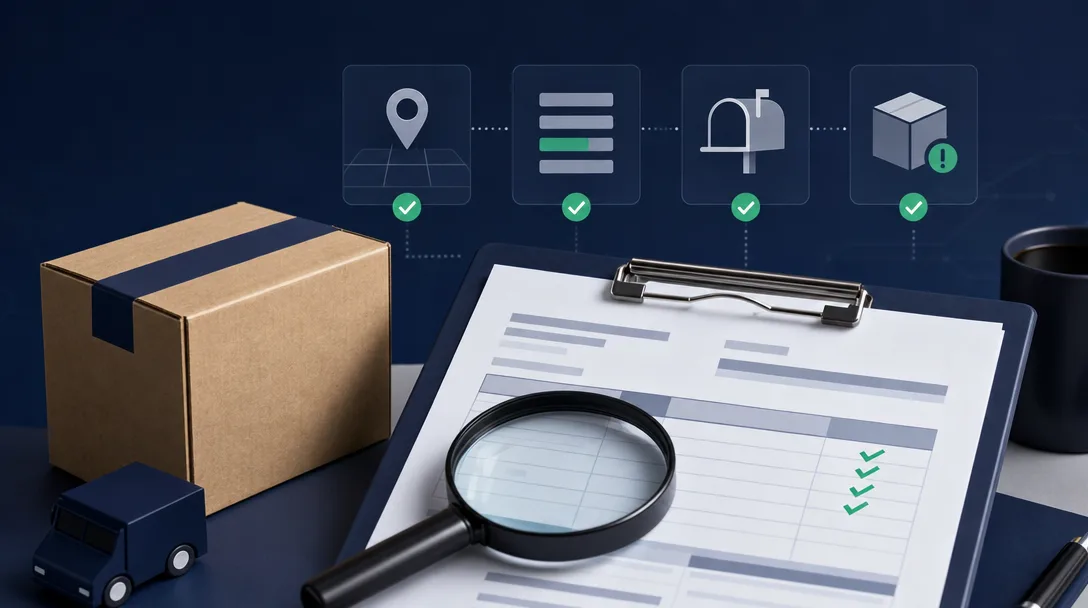
What Is the FedEx Address Correction Fee in 2026?
A FedEx address correction fee is a charge FedEx applies when it corrects, verifies, or reclassifies a shipment's destination address after the shipper has already paid for the label. Published FedEx surcharge tracking for 2026 lists the charge for U.S. Package Services at $24 per correction, up from $22.50 in 2024 and more than 70% higher than the $14 FedEx charged for the same fee back in 2017.
FedEx's own 2026 surcharge and fee schedule, the document that should serve as the primary confirmation, returned a system error when checked for this article. Treat the $24 figure as the most recently published estimate rather than a number pulled straight from FedEx's live page. Before you accept an address correction line item on your invoice, verify it against the exact dollar amount your carrier account currently shows, since fee schedules can update mid-year without much notice.
What Triggers a FedEx Address Correction Charge?
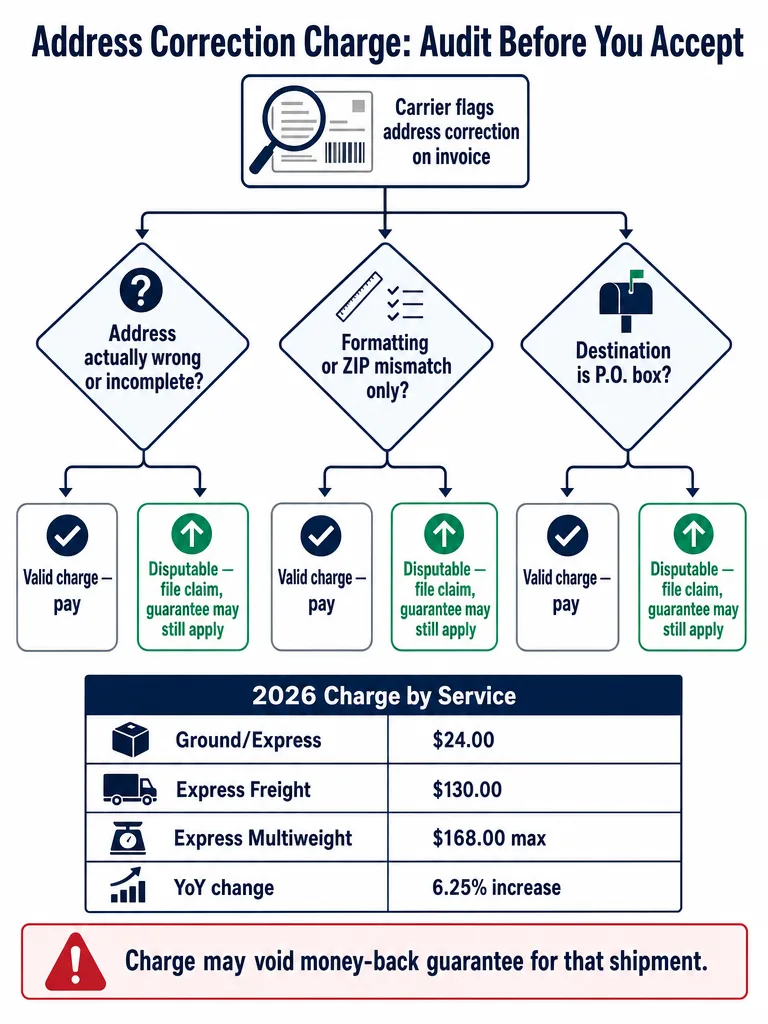
FedEx applies an address correction charge for two broad reasons, and knowing which one hit your invoice determines whether the charge is legitimate. The first is a wrong or incomplete address supplied at label creation. The second is a destination that is a P.O. box or carries a P.O. box ZIP code inside the U.S. FedEx adds the surcharge whenever a shipment routes to one of these, regardless of how carefully the original label was typed.
Neither reason requires FedEx to prove the package actually failed to deliver. The correction can post the moment FedEx's system flags a mismatch during processing, well before the truck leaves the facility. That's why the charge shows up even on packages that arrived on time, and why it's worth checking which trigger applies before you assume the fee reflects a real mistake on your end.
Can a Valid Address Still Get Flagged for Correction?
Yes. A technically correct address can still trigger a FedEx address correction fee if the format doesn't match what FedEx's system expects. Street directionals and suffixes are the most common failure point: an address needs to be accurate, but it also needs to be formatted the way FedEx's validation logic reads it.
Following official USPS standard suffix abbreviations is the safest formatting baseline, since that's the reference FedEx's own validation checks tend to follow. If a correction fee shows up on an order where the customer's address was clearly right, check formatting first, before you dispute or accept the charge.
Does an Address Correction Fee Affect Your FedEx Money-Back Guarantee?
Yes, and this is the part most invoice reviews miss. Once a shipment incurs an address correction fee, FedEx's on-time or it's-free guarantee no longer applies to that package. A shipment that runs late after triggering a correction may not qualify for a service-guarantee refund, even if the delay traces back to FedEx's own handling.
An address correction charge can cost you twice: the fee itself, and the refund you'd have otherwise been owed for a late delivery on that same package. UPS shippers face a comparable tradeoff on their own carrier's guarantees, worth checking against how to claim UPS late delivery refunds before assuming a service guarantee still applies to a flagged shipment.
What Should You Check on Your Invoice Before Accepting an Address Correction Charge?
Don't treat an address correction line item as automatically valid. Run it through a short sequence before you write it off as a cost of doing business:
- Pull the original shipment record. Compare the address you entered at label creation against the address FedEx billed as "corrected." If they match, the charge may be a system-side formatting flag, not a real error.
- Check the source of the address. If it came from a customer checkout field, a marketplace order, or a manual entry, confirm which one it was. Manually typed addresses are the most common source of genuine errors.
- Review formatting against USPS suffix standards. Abbreviated directionals and suffixes are the most frequent cause of a valid address getting flagged.
- Confirm P.O. box status. If the destination is a P.O. box or carries a P.O. box ZIP code, the charge is likely valid under FedEx's own rules, and disputing it won't succeed.
- Check whether it affected your service guarantee. If the shipment also ran late, note that the correction may have already voided your refund eligibility for that package.
A real invoice audit checks accessorial fees like address corrections line item by line item against the shipment record, not as a lump total. If you'd rather not run this checklist manually every month, get your free shipping audit and have each address correction charge checked against your own shipment data instead.
How Do You Tell a One-Off Address Error From a Recurring Data Problem?
A single address correction fee is a mistake. Five corrections a month from the same fulfillment source is a data problem. The distinction matters because one gets fixed with a phone call, and the other keeps costing you every week it goes unaddressed.
Look for the charge repeating against the same customer database, the same integration, or the same warehouse location. If corrections cluster around one sales channel, one checkout form, or one batch of imported records, the root cause usually sits upstream of the carrier, not with FedEx's flagging logic. A consistent invoice audit turns a string of unrelated-looking line items into a visible pattern you can actually correct, instead of a rounding error you keep paying indefinitely. Tracking correction fees by source over a full billing cycle, not just by shipment, is what separates a fixable process gap from a cost you'll never stop absorbing.
FedEx Address Correction Fees by Service: Ground, Express, Freight, and Multiweight
The address correction charge is not one flat number across every FedEx service. Confirmed 2026 pricing is limited to the $24 U.S. Package Services rate noted above. A full 2026 breakdown by freight and multiweight program isn't available from a confirmed FedEx source at the time of writing. The most recently published rates by service, current for 2025, show how far the gap runs between package and freight tiers:
| Service | Cost per correction |
|---|---|
| Ground and Express, U.S. and International Package Services | $24.00 |
| U.S. Express Freight Services | $130.00 |
| FedEx Express Multiweight | $168.00 (maximum) |
| FedEx Ground Multiweight | $72.00 (maximum) |
If you ship on any freight or multiweight program, don't assume the $24 package-service rate applies to your invoice. Check the specific service line before you dispute or accept the charge, and treat any 2026 freight or multiweight figure you see elsewhere as unconfirmed until it matches your actual bill.
How Can You Prevent FedEx Address Correction Fees Before They Hit the Invoice?
Most address correction fees are preventable before the label ever prints. Three fixes cut most of the risk: keep customer databases current so they hold the latest address on file, remove duplicate or outdated records that resurface old addresses during reorders, and use address autocomplete tools at checkout so customers can't submit typos or incomplete entries.
Formatting matters just as much as accuracy. Standardizing street suffixes and directionals to official USPS abbreviations helps, since FedEx's validation checks tend to follow that same standard. Address verification software takes this further by cross-referencing entries against the U.S. Postal Address Database before a shipment ever gets created, catching the formatting mismatches that flag otherwise valid addresses.
When Does an Address Correction Fee Signal a Bigger Invoice Problem?
One address correction fee rarely breaks a shipping budget. What it signals is worth more than the $24. Industry benchmarks on carrier invoice accuracy put typical error-driven overpayment at 1-5% of total shipping spend, with as many as 5% of carrier invoices containing costly mistakes somewhere in the billing.
An address correction charge is often the visible edge of a billing pattern that includes misapplied surcharges, dimensional weight errors, and missed service-guarantee refunds sitting elsewhere on the same invoice. Checking it against the same benchmarks you'd use for the 2026 UPS and FedEx surcharge list gives you a fuller picture than reviewing the correction fee in isolation.
For businesses that don't have the staff hours to run that review line by line every month, Kadima Logistics audits FedEx, UPS, and other carrier invoices against benchmark rates and writes up the findings, including recurring accessorial charges like address corrections, in a savings analysis based on your own shipment data. Get your free shipping audit at kadimalogistics.com/contact.
Frequently asked questions
What is the FedEx address correction fee in 2026?
FedEx charges $24 per correction for U.S. Package Services in 2026, up from $22.50 in 2024 and more than 70% higher than the $14 rate charged in 2017. The fee applies when FedEx corrects, verifies, or reclassifies a shipment's destination after the label has already been paid for. Confirm the exact amount against your own carrier account, since fee schedules can update mid-year without much notice.
What triggers a FedEx address correction charge?
FedEx applies the charge for two reasons: a wrong or incomplete address at label creation, or a destination that's a P.O. box or carries a P.O. box ZIP code. FedEx doesn't need proof the package failed to deliver — the correction can post the moment its system flags a mismatch during processing, even on packages that arrive on time.
Can a correctly entered address still trigger a FedEx address correction fee?
Yes — formatting, not accuracy, is often the real trigger. Skipping standard abbreviations for directionals or street types (N, S, E, W, or ST, AVE, FWY) can cause FedEx's system to misread the abbreviation as part of the street name. Following official USPS standard suffix abbreviations is the safest way to format an address so it matches what FedEx's validation logic expects.
Does a FedEx address correction fee affect the on-time money-back guarantee?
Yes — once a shipment triggers an address correction fee, FedEx's on-time or it's-free guarantee no longer applies to that package. A shipment that runs late after a correction may not qualify for a service-guarantee refund, even if the delay traces back to FedEx's own handling. That means a flagged shipment can cost twice: the correction fee itself, plus the refund you'd have otherwise been owed.
How much does a FedEx address correction cost on freight or multiweight shipments?
Address correction fees run far higher outside standard package services: $130 for U.S. Express Freight Services, up to $168 for FedEx Express Multiweight, and up to $72 for FedEx Ground Multiweight, based on the most recently published rates. A full confirmed 2026 breakdown by freight and multiweight program wasn't available at time of writing, so check the specific service line on your invoice before assuming the $24 package rate applies.
How can you prevent FedEx address correction fees before they hit the invoice?
Keep customer databases current, remove duplicate or outdated records, and use address autocomplete tools at checkout to stop typos before they reach a label. Standardizing street suffixes and directionals to official USPS abbreviations also matters, since FedEx's validation checks tend to follow that same standard. Address verification software adds another layer by cross-referencing entries against the U.S. Postal Address Database before a shipment gets created.
Sources
- Shipping Rate Changeswww.fedex.com
- 2026 changes to FedEx surcharges & feeswww.fedex.com
Keep reading

One short note, every other Tuesday. Nothing else.
The patterns we're seeing across thousands of carrier invoices, written up tight. Unsubscribe with one click.