Amazon Shipping Eligibility vs UPS for Small Parcels
Amazon Shipping works best for sub-5-pound metro parcels and 10 to 1,000 packages a day. UPS still wins on broader coverage, faster service, and published pricing.
Is Amazon Shipping cheaper than UPS for small parcels?
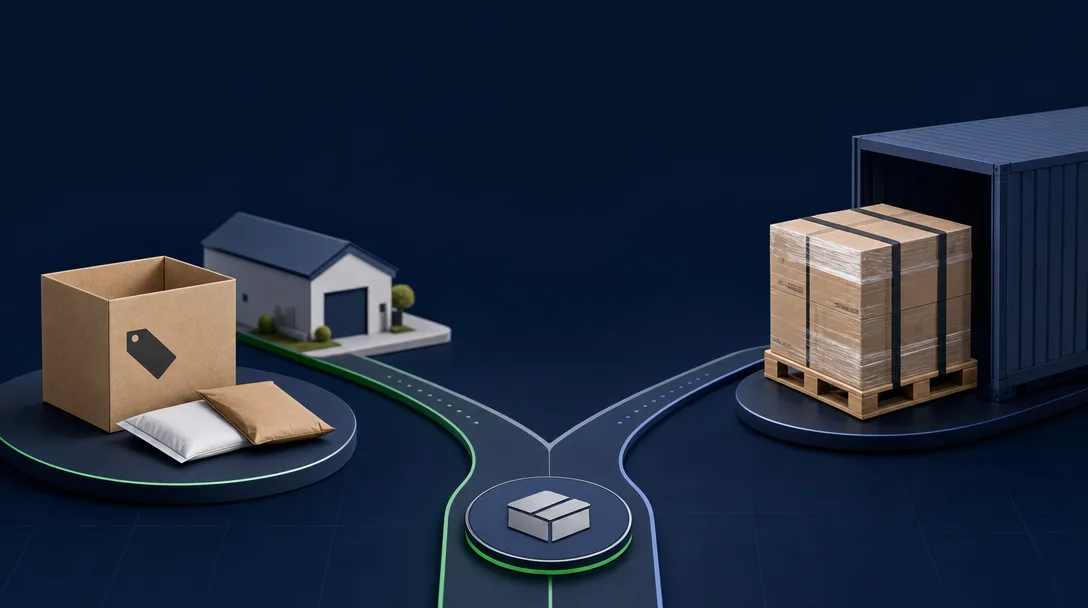
Amazon Shipping fits businesses shipping 10 to 1,000 packages a day with mostly sub-5-pound parcels headed to metro addresses, according to Amazon's own shipping page, while UPS covers a far wider weight and service range. Amazon Shipping vs UPS for small parcels is an eligibility question first, a price question second.
Retail Dive reported that Amazon Shipping's 2024-2025 push focused on packages under five pounds headed to metro-area addresses. That's a narrower lane than UPS covers. UPS Simple Rate, by contrast, works in all 50 states for any box up to 1,728 cubic inches and 50 pounds, according to UPS's own flat-rate shipping page.
Amazon Shipping's pitch is a rate card issued after you set up an account, with savings advertised up to 40% against what you're currently paying. You can't compare that card to UPS Simple Rate's published tiers until you've actually applied for one. That's the real problem with treating this as a simple price comparison: one side publishes its price list, the other hands you a number after you sign up. Run your own invoice data against both before you decide.
Amazon Shipping vs Amazon-partnered UPS for FBA: two different decisions
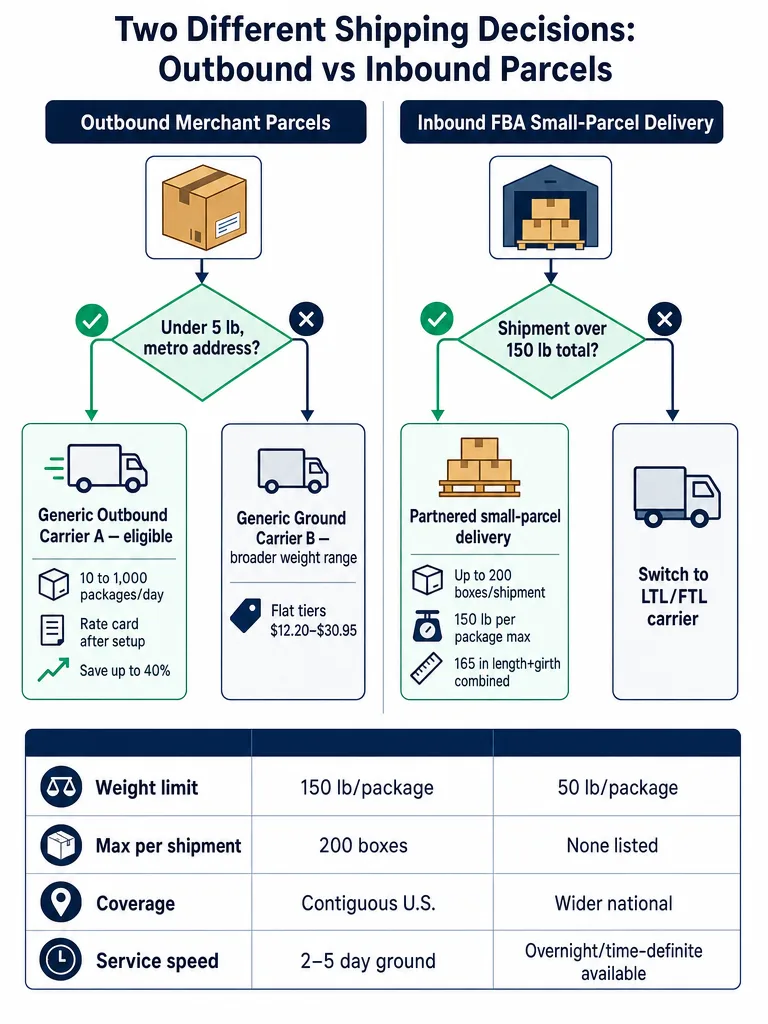
Amazon Shipping and Amazon-partnered UPS solve two different shipping problems for you, and mixing them up leads to the wrong comparison. If you're shipping orders to your own customers, you're looking at Amazon Shipping. If you're sending inventory into Amazon's fulfillment centers for FBA, you're picking a carrier inside your Seller Central shipping plan, and Amazon-partnered UPS small-parcel delivery (SPD) is one of those options, not a competitor to Amazon Shipping.
Amazon Shipping is what Amazon markets on its small-and-medium-business page: a ground network you use to deliver orders to your own customers, with account setup, a rate card, and claimed savings up to 40%. That's an outbound decision about how you fulfill your own sales.
Amazon-partnered UPS small-parcel delivery is a different workflow entirely. It's the carrier option FBA sellers choose inside their shipping plan to move boxes of inventory from a warehouse or 3PL into an Amazon fulfillment center. Amazon's own guidance, quoted in a Seller Forums discussion on choosing between SPD and LTL, caps these shipments at 200 boxes, with per-package limits on weight and size.
If you're deciding how to ship customer orders, you're weighing Amazon Shipping against UPS or FedEx on your own account. If you're deciding how to get stock into Amazon's warehouses, you're choosing between Amazon-partnered UPS SPD and an LTL carrier instead, a question with entirely different weight and box-count rules.
Who qualifies for Amazon Shipping?
Amazon Shipping is Amazon's merchant ground-delivery program, open to businesses shipping 10 to 1,000 packages a day, according to Amazon Shipping's small-and-medium-business page. That range is your first eligibility filter: if you're well below 10 packages a day or far above 1,000, you likely fall outside the program Amazon is actively marketing.
Inside that volume range, Amazon says you can set up an account to receive a rate card and save up to 40% against current shipping costs, though the exact figures aren't published until you're in the account. Amazon also claims its network covers "the vast majority" of addresses in the contiguous U.S., including both business and remote locations, which matters if a meaningful share of your volume ships outside metro cores.
There's no published weight or dimension ceiling for Amazon Shipping's merchant parcels in Amazon's own materials, which is a real gap if you're trying to pre-qualify a specific SKU. For a closer look at where Amazon Shipping tends to beat UPS or FedEx on actual invoice cost, see when Amazon Shipping beats UPS or FedEx on cost.
UPS Simple Rate vs Amazon Shipping rate card: how the pricing actually compares
UPS publishes its full Simple Rate price list before you ever request a quote; Amazon Shipping doesn't hand you a rate card until you've set up an account. That one difference changes how you shop each option. UPS Simple Rate charges by box size and delivery speed, with five tiers running from $12.20 to $30.95, according to UPS's own flat-rate shipping page. Amazon Shipping instead issues a rate card tied to your account and volume, with savings advertised up to 40% but no public tier chart.
| Factor | UPS Simple Rate | Amazon Shipping |
|---|---|---|
| Pricing model | Flat rate by box size and speed | Rate card issued after account setup |
| Price range | $12.20 (Extra Small) to $30.95 (Extra Large) | Not published; up to 40% savings claimed |
| Weight cap | 50 lb | Not publicly listed for merchant parcels |
| Size cap | 1,728 cubic inches (one cubic foot) | Not published |
| Delivery speed options | Next day, second day, three-day, five-day | Two-to-five-day ground |
| Account required | No | Yes |
| Coverage | All 50 U.S. states | Contiguous U.S., described as "vast majority" of addresses |
UPS Simple Rate is the only side of this comparison you can price out before signing anything, which makes it a useful benchmark even if you end up on Amazon Shipping. If Amazon's eventual rate card doesn't beat Simple Rate's published tier for your box size, you have your answer without opening an account. For a broader look at where surcharges distort published rates on either carrier, see the 2026 UPS and FedEx surcharge list.
Which carrier fits your package profile: weight, size, and coverage
Your package weight, size, and delivery address decide this faster than any rate comparison. Amazon Shipping's documented strength is lightweight parcels under five pounds moving to metro addresses, per Retail Dive's reporting on the service's 2024-2025 focus. UPS covers a wider weight range, more delivery speeds, and broader geography, with UPS Simple Rate handling anything up to 50 pounds and 1,728 cubic inches before standard UPS rates take over. Match your package profile to the carrier built for it before you compare price.
| Package profile | Better fit | Why |
|---|---|---|
| Under 5 lb, metro delivery | Amazon Shipping | Retail Dive reported this was Amazon Shipping's core 2024-2025 focus |
| Up to 50 lb, flat domestic rate | UPS Simple Rate | Published $12.20-$30.95 tiers, up to 1,728 cubic inches |
| Over 50 lb or over 1,728 cubic inches | Standard UPS rates | Simple Rate excludes packages past these limits |
| Needs overnight or time-definite delivery | UPS | Amazon Shipping currently runs two-to-five-day ground only, per Retail Dive |
| Remote or rural destinations | UPS | Amazon Shipping covers the "vast majority" of contiguous U.S. addresses, not a guaranteed full map |
If most of your volume sits in that first row, lightweight and metro-bound, Amazon Shipping is worth an eligibility check. If your parcel mix runs heavier, needs guaranteed delivery dates, or ships into rural zip codes, UPS still carries more of that load today. For how crossing specific volume thresholds changes what carriers will negotiate, see small parcel shipping rates in 2026.
FBA inbound small-parcel delivery: Amazon's partnered-UPS rules
Amazon's small-parcel delivery (SPD) program for FBA inbound shipments runs on hard box-count and per-package limits, not account-level eligibility. A shipment with a partnered carrier like UPS tops out at 200 boxes, and each package is capped at 150 lb, 165 inches in combined length and girth, and 108 inches in length, according to Amazon guidance quoted in a Seller Forums discussion on choosing between SPD and LTL. Check these limits before you build your shipping plan, not after.
- Box count. A single SPD shipment with a partnered carrier tops out at 200 boxes.
- Per-package weight. Each individual box cannot exceed 150 lb.
- Combined length and girth. Each package is capped at 165 inches in length and girth combined.
- Package length alone. No single package can exceed 108 inches in length.
- Total shipment weight. If the full shipment weighs more than 150 lb in aggregate, Amazon's guidance points sellers toward a partnered LTL or FTL carrier instead of SPD.
That last rule trips up sellers more than any other. A shipment can meet every per-box limit, stay under 200 boxes, and still exceed 150 lb in total weight once you add all the boxes together, which is exactly the scenario a seller described in the forum thread: 76 boxes at 20 lb each, each box individually compliant, but roughly 1,520 lb total. Amazon's guidance frames the 150 lb total threshold as something to "consider" rather than a hard block, so sellers in that gray zone have reported using SPD successfully above it. Run the math on total shipment weight before you build the plan, not after.
When does UPS still beat Amazon Shipping for small parcels?
UPS beats Amazon Shipping today on delivery speed options and published package limits, the two places Amazon Shipping hasn't built out yet. Retail Dive reported that Amazon Shipping has expanded availability and pitched pricing competitive with FedEx and UPS, but the service still runs on two-to-five-day ground only in the contiguous U.S. If your shipments need a guaranteed delivery date or a documented weight and size ceiling before you ship, UPS is still the safer bet.
That ground-only window rules out any shipment with a delivery deadline. UPS still owns next-day and second-day service in a way Amazon Shipping's public materials don't match. Amazon Shipping's own weight and dimension limits for merchant parcels also aren't published anywhere in its materials, which makes it hard to pre-qualify a heavier carton before you apply.
Service guarantees are the other open question. The available sources here don't provide a directly comparable Amazon Shipping claims or service-guarantee policy, which makes it hard to weigh against UPS on that specific point. For more on how UPS handles delivery issues on its own services, see UPS late delivery refunds.
How to choose between Amazon Shipping and UPS for your parcel mix
Choosing between Amazon Shipping and UPS comes down to sorting your own parcel data by weight, destination, and delivery deadline, then testing both carriers against it. Rather than picking one carrier for everything, route your volume by package profile: lightweight metro parcels toward an Amazon Shipping eligibility check, heavier or time-definite shipments toward UPS. Work through weight, coverage, and deadline needs in that order before you request a quote from either carrier.
- Sort your volume by weight and size. Pull a sample of recent invoices and bucket shipments under 5 lb, under 50 lb, and over 50 lb.
- Check your delivery footprint against each network. If most addresses are metro, Amazon Shipping's coverage claim is worth testing. If a meaningful share is rural or outside the contiguous U.S., UPS stays primary.
- Flag anything that needs a delivery deadline. Time-definite shipments rule out Amazon Shipping's current two-to-five-day ground service by default.
- Get a real quote from each program against your actual invoice data, not published rate cards. Amazon Shipping's rate card and UPS's negotiated pricing both depend on your real volume and mix, not a generic published tier. Compare both carriers' actual rates against the same invoice data instead of relying on marketing pages.
- Decide which carrier handles which lane, not which carrier wins overall. Route lightweight metro volume one way and heavier or deadline-sensitive volume the other, and revisit the split as your volume changes. If you want to look at shared-volume pricing options instead of negotiating alone, see what GPO shipping rates are and when they make sense.
The deliverables, in plain English: know your weight bands, know your coverage gaps, and get both carriers' real numbers before you move a single package.
Frequently asked questions
Does Amazon Shipping work for businesses that aren't Amazon marketplace sellers?
Yes. Amazon Shipping is a merchant ground-delivery program open to any business shipping 10 to 1,000 packages a day, according to Amazon's own small-and-medium-business page, regardless of whether you sell on Amazon's marketplace. It's a separate decision from FBA inventory shipping, where Amazon-partnered UPS small-parcel delivery moves stock into fulfillment centers instead of delivering orders to your own customers.
Does Amazon still use UPS for deliveries?
Yes, but less than before. Amazon Logistics now handles roughly two-thirds of Amazon's U.S. package deliveries, and UPS agreed in January 2025 to cut its Amazon delivery volume by more than 50% by the second half of 2026. UPS still delivers a meaningful share of Amazon's parcels today, and Amazon accounted for nearly 12% of UPS's total 2024 revenue.
Does UPS offer overnight delivery that Amazon Shipping doesn't?
Yes. UPS Simple Rate includes next-day and second-day delivery options alongside three-day and five-day service, while Amazon Shipping currently runs two-to-five-day ground only, according to Retail Dive's reporting on the service. If a shipment needs a guaranteed delivery date, UPS still covers that need; Amazon Shipping's public materials don't include a comparable expedited tier yet.
Can I access Amazon Shipping's rates through my own shipping software?
Yes. Amazon's small-and-medium-business shipping page states you can access Amazon Shipping rates either by setting up a direct account for a rate card or by connecting through your preferred third-party shipping software. Both paths lead to the same ground network and claimed savings of up to 40%, so the choice comes down to whether you want a standalone account or an integration with tools you already use.
Does Amazon Shipping offer weekend pickup?
Yes. Amazon's small-and-medium-business shipping page advertises pickup and delivery seven days a week, managed through Shipper Central or the Amazon Shipping app. That's a wider pickup window than many flat-rate carrier programs offer by default, though it doesn't change the service's two-to-five-day ground-only delivery window once a package is picked up.
What's the maximum package weight Amazon Shipping accepts?
Amazon hasn't published one. Amazon's own materials for Amazon Shipping don't list a weight or dimension ceiling for merchant parcels, unlike UPS Simple Rate, which caps flat-rate boxes at 50 pounds and 1,728 cubic inches before standard UPS rates apply. That gap makes it hard to pre-qualify a heavier carton for Amazon Shipping before setting up an account.
Sources
- Small-parcel delivery to Amazonsellercentral.amazon.com
- SPD vs LTL Shipping Mode for FBA - sellercentral.amazon.comsellercentral.amazon.com
- Shipping Options - Amazon Customer Servicewww.amazon.com
- Shipping for Small and Medium Businesses - Amazon Shippingshipping.amazon.com
Keep reading
One short note, every other Tuesday. Nothing else.
The patterns we're seeing across thousands of carrier invoices, written up tight. Unsubscribe with one click.